

TechWrit AI
AI agent to generate, rewrite, and review technical docs
2 followers
AI agent to generate, rewrite, and review technical docs
2 followers
Engineers use AI tools (Copilot, Cursor, ChatGPT) to draft docs quickly, but the results often lack usability. When documenting an API endpoint, AI may produce polished paragraphs yet miss structured references: parameter tables, request/response examples, error codes, and authentication details in the required format. Generic AI tools describe code instead of delivering the precise documentation developers need.
Interactive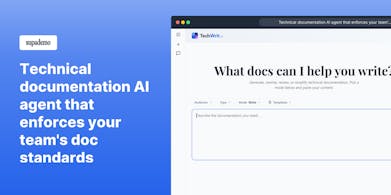
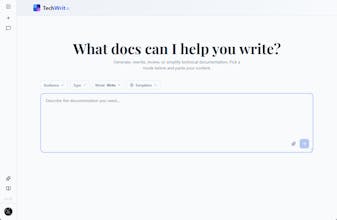
Free Options
Launch Team / Built With


Hey Product Hunt! I'm Patricia McPhee — a technical writer with 30 years in the industry. I've documented APIs, SDKs, and developer platforms at Microsoft, Amazon, Facebook/Oculus, GE Healthcare, and more.
Here's why I built TechWrit AI:
Every documentation team has run this experiment. Paste code into ChatGPT. Ask it to write docs. You get paragraphs. Nice paragraphs. But not documentation.
An API reference isn't a description of what an endpoint does. It's a structured document with parameters, types, response examples, error codes, and authentication details. Generic AI doesn't produce that structure because it doesn't understand what technical documentation is.
So I built a documentation engine that does.
TechWrit AI takes code as input and generates structured technical documentation as output. API references, SDK guides, end-user how-tos, and release notes — all following your team's style guide, glossary, and terminology. Not because contributors read the wiki. Because the standards are built into the engine.
What makes this different from every other AI writing tool:
Code-aware, not prompt-dependent. The input is code, configs, and specs — not natural language prompts. The output is structured documentation, not paragraphs.
The glossary writes, not just checks. Define a term with its definition and synonyms. The AI uses that context when generating documentation. "Callback URL" doesn't get flagged — "webhook" gets used correctly from the start.
Multi-surface. Web app with 14 modes, VS Code extension with native diagnostics, and a REST API for CI/CD pipeline integration. Same standards everywhere.
Transparent. The full system prompt is visible. No magic. These are the same documentation standards I've enforced across hundreds of PR reviews, now built into the generation process.
The free tier gives you 10 requests/month. Try feeding in some code and see what comes out.
I'd love feedback from technical writers, DevRel professionals, and developers who document their own code. Specifically: what documentation types should I add next? What standards does your team struggle to enforce?
Drop your API code, get an OpenAPI spec back — TechWrit AI v1.7.0
We just shipped a feature that API teams have been asking for: OpenAPI 3.0 generation directly from your source code.
Here's how it works:
Upload your route handlers, controllers, or endpoint files.
TechWrit AI detects the API patterns automatically and asks what format you want.
Pick OpenAPI YAML — processing starts instantly.
Download a valid .yaml spec ready for Swagger UI, Redoc, or Postman.
No manual setup. No switching modes. The app reads your code — Express, FastAPI, Spring Boot, ASP.NET, Azure Functions, Go net/http, and more — and figures out what you need.
You can still choose Markdown if you want human-readable API docs instead. Both options apply your style rules and glossary automatically.
What else is new in v1.7.0:
Smart file detection — attach code and the app auto-selects the right mode
Inline format prompt — asks follow-up questions right inside the input area, like you'd expect from a modern AI tool
Bug fixes for frontmatter preservation and heading casing in rewrites
We built this because writing OpenAPI specs by hand is tedious, and the code already has everything you need. Now the spec writes itself.
Try it at techwrit.ai