
TabTasker
Zero servers. Total privacy. Your new favorite toolbox.
420 followers
Zero servers. Total privacy. Your new favorite toolbox.
420 followers
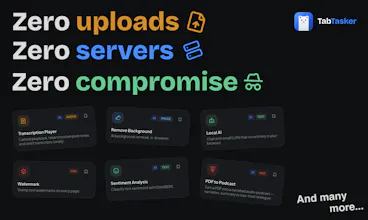
A free web toolbox running 100% offline in your browser. We built TabTasker so you can edit PDFs, process images, transcribe audio, and access 50+ utilities without uploading a single file. Lastly, it is free to use.



Free
Launch Team / Built With


Framer AI AgentsDesign and publish professional sites with AI
Promoted
The zero-upload model is the right call for this category. We ran into serious friction getting Tuple's SMB clients to adopt any tool that required cloud access to their files — IT approval cycles alone killed two POCs. The instinct to keep processing local is exactly what removes that blocker. One thing worth testing: the use case that tends to unlock stickier retention for productivity tools like this is the "I just saved myself from a real mistake" moment, not the "this is convenient" moment. If you can instrument which utilities trigger that feeling, you'll know exactly which to lead with in copy.
@thekrew
This is a sharp framing, and the procurement angle especially lands. The thing people underrate about local-first is that it does not just protect data, it deletes an entire approval step. There is no DPA to sign, no vendor security review, no "where does our data actually go" thread with IT, because the answer is nowhere, it stays in the tab. Same thing you saw at Tuple: the blocker is rarely the feature, it is the procurement cycle wrapped around the feature.
Your "saved myself from a real mistake" point is the one I want to sit with, because I think you are right that it is a different cluster of tools than the convenient ones. Convert, compress, merge are the convenience moments. The mistake-prevention moments are redact, EXIF and metadata stripping, and password strength. Redact is the clearest. The classic disaster is a PDF with black boxes drawn over text that is still selectable underneath, which is how plenty of organizations have leaked names over the years. Ours rasterizes the affected pages and destroys the text layer, and it refuses to produce a file at all if that step fails rather than handing you a falsely redacted document. That is squarely an "you almost shipped a real mistake" tool.
The hard part with instrumenting it is that the saved-myself moment is invisible by design. The user never sees the GPS coordinates they did not leak or the SSN that did not get copied out, so you cannot measure the feeling directly. The proxy is probably retention by tool: whether people who land on redact or metadata strip come back at a different rate than people who run a one-off convert. That is the cut worth measuring, and it would genuinely reshape what we lead with in copy. Appreciate you naming it this precisely.
@caglar_su @mfethio @acanturgut I like the privacy-first angle here. A lot of productivity tools become less useful when people hesitate to put real work into them, so keeping things local and lightweight can actually make the workflow more practical.
@alpertayfurr Thank you for your kind comment. We completely agree with you.
The 50+ utilities claim — does that include specialized things like PDF redact, barcode generator, or color palette extraction, or is it mostly the standard converter/formatter suite? What are the most-requested tools that aren't there yet?
Pulling ffmpeg.wasm out is the choice I'd want to hear more about! Was it bundle bloat, browser memory ceilings or something specific to the codec coverage you needed? Asking because every WASM-first project I've watched eventually has to make a "we can't ship the full library" call. COngrats on the launch!
Running Whisper via ONNX Runtime Web is a smart call, and opting out of the Web Speech API to keep audio off vendor servers is the right tradeoff. On lower-end machines without WebGPU, how noticeable is the WASM fallback performance hit?
Interesting zero-server approach. How does the in-browser OCR handle large or multi-column PDFs once the model's cached?
Very cool! I always ask our designer to tweak my PDF every month :) He probably already hates me for it.