Tabstack is a web data and automation API that delivers reliable structured output. Pass a URL and a schema, get back JSON that matches every time. Run research in one call and get cited answers back. Automate browsers without running infrastructure. The intelligence is built into every API call. No scraper to build, maintain, or watch break when a site changes. Built at Mozilla.
This is the 2nd launch from Tabstack. View more
Tabstack Web Research
Launched this week
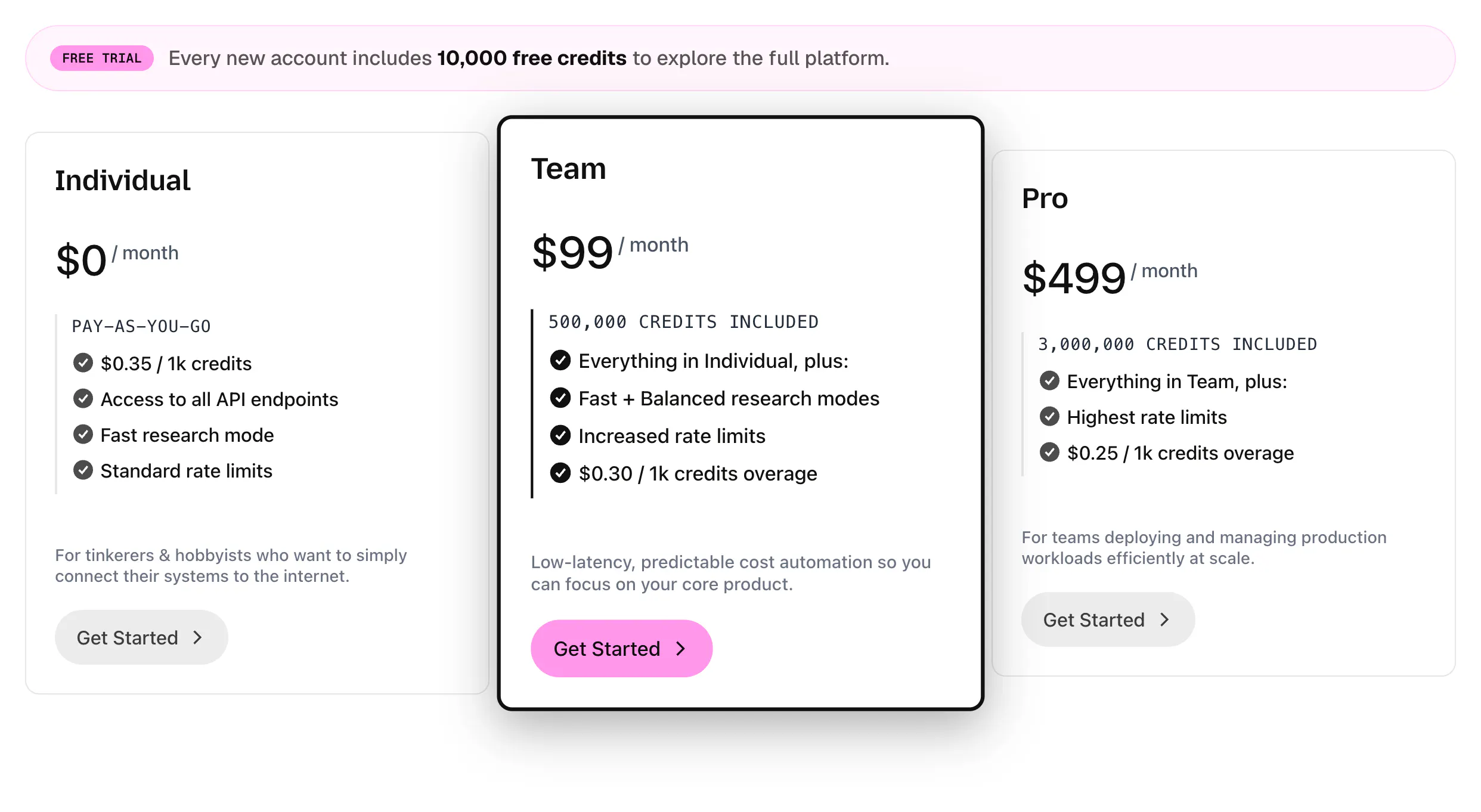
/research gives your app or agent cited answers from the live web in one API call. Not a pre-indexed corpus: the actual live web. Every request comes back with source URL's users can verify. Source selection, synthesis, and citation formatting are all inside the call. You write or maintain none of that code. Built for legal, financial, and competitive intel, where a wrong answer is a liability. Free to try.


Free Options
Launch Team


Tabstack
We launched /research today, a single API call that runs a full web research agent and returns cited answers.
Here's the pattern it replaces:
// What most teams build:
// 1. Search the web (or an index)
// 2. Fetch and read relevant pages
// 3. Synthesize across sources
// 4. Validate citations
// 5. Format for streaming
// 6. Debug all of the above forever
// What /research does:
That's it. The orchestration lives inside the call. Your codebase doesn't own it.
First 10,000 credits are free. Happy to answer questions in the comments. Give it a try → https://tabstack.ai/web-research
Three things that matter about how we built this:
1. Citations are not optional.
Every claim comes back with a source URL. Users can verify where the answer came from. That's the difference between an AI feature people trust and one they don't.
2. Live web, not an index.
Pre-indexed research APIs (Exa, Perplexity) are fast and good for broad questions. /research goes to the live web on every call. For legal, financial, and competitive intelligence work — where the answer needs to be current and sourced — that's the relevant difference.
3. SSE streaming built in.
Users watch it work in real time. No spinning wheel. Progress events as sources are found, then a complete event with the full report and all citations.
Tabstack
@tessak22 S/O for this new launch! Psyched to be part of this journey
Tabstack
@fmerian We're thankful for your part in the journey!
Tabstack
@tessak22 just the beginning
Tabstack
happy to share this new collaboration with @tessak22 and the @Tabstack team!
First launched on @Product Hunt last April, the @Mozilla-backed platform is launching again today, introducing a new /research endpoint.
Run agents to explore the web and answer complex questions with precision, all in a single API call. Simple, accurate, and secure. Read the docs to learn more: https://docs.tabstack.ai/guides/research/
There are multiple products in the browser automation category - @Tabstack just hits differently.
Start for free: https://tabstack.ai/web-research
Tabstack
@fmerian So thankful for you and the support! It's been a ton of fun bringing this to life with you!
mailX by mailwarm
How do you pick sources and avoid low quality SEO pages, and can users whitelist domains?
Tabstack
@karimbenkeroum Great question, and TL,DR: The system prioritizes official docs, ignores SEO-optimized posts, and filters out marketing noise and DOM boilerplate during content extraction. That's it!
Give it a spin at tabstack.ai - curious to have your feedback about the onboarding flow and overall DX
Tabstack
@karimbenkeroum We don't support a domain whitelist, but I'm submitting that as a possible feature request. Thanks for your engagement and support.
The “citations are not optional” stance is exactly right, especially for legal / financial / competitive-intel use cases.
One thing I’d be curious about: do you treat citations as source links only, or as claim-level support? In research workflows, a source URL is helpful, but the trust really jumps when the user can see which sentence or assertion each source is meant to support, plus whether another source disagreed or was skipped as stale.
That extra bit of provenance would make the output much easier to use in a report without forcing someone to re-run the whole research process manually.
The live-web approach vs pre-indexed APIs is a real tradeoff I've thought about while building research features. Pre-indexed is faster and cheaper at scale, but for anything time-sensitive — earnings reports, product launches, competitive moves — the index lag can be 24-48h which is basically useless. Live web is the only option there.
One thing I'm curious about: when sources conflict, the "prioritize most authoritative source" approach makes sense, but how do you define authoritative? Domain reputation, recency, citation count? I've seen cases where a newer but less-established source had the correct info and an older authoritative source was stale. Would love to see the conflict resolution logic exposed more transparently in the output.
We built research automation for B2B outbound -- deep-research every lead before outreach goes out. The hard part was never the search, it was the citation chain. At scale, when you're processing 50 prospects a day, the agent needs to know not just what it found but how confident to be in the source. How does Tabstack handle conflicting sources on the same question? Does the /research endpoint surface confidence signals per claim, or is it a clean narrative output? That distinction matters a lot for any downstream workflow acting on the data.
The citations part is what matters most to me here. For research workflows, a good looking answer is not enough if people cannot check where it came from. Live web also makes sense for topics that change quickly, especially competitive research or financial updates. How do you handle cases where sources disagree with each other? Do you show conflicting findings or choose the strongest source?
Tabstack
Exactly. From my perspective, it's all about trust - especially these days - and @Tabstack has an unfair advantage here, backed by @Mozilla. Read their manifesto here: mozilla.org/about/manifesto
re: conflict resolution.
Good question! If the loop encounters conflicting information, the system resolves this by verifying the context. The result is a reconciled data point that prioritizes the most authoritative source. Learn more in this blog announcement: https://tabstack.ai/blog/tabstack-research-verified-answers
Hope this helps!