
SUPERWISE Sentinel
The AI Gateway
57 followers
The AI Gateway
57 followers
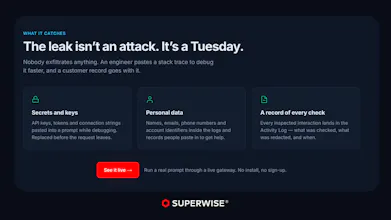
SUPERWISE Sentinel is an enterprise AI gateway. Mac, Windows, Linux – Deploy a localized proxy, capture 100% of your LLM traffic, and redact secrets, PII, and toxic content at the edge. Your raw data never leaves your perimeter.
Interactive




Free Options
Launch Team / Built With


AI calls can expose secrets and personal information. Sentinel routes them through a lightweight proxy that redacts sensitive data and logs activity—without code changes. Your prompts stay in your environment.
Setup takes about five minutes.
I've worked with teams adopting AI at different speeds, and governance often becomes an afterthought. What I like about Sentinel is that it helps organizations gain visibility and control without slowing down innovation or forcing major code changes. That balance between security and developer productivity is important. Great work by the team! 👏
A few months into running Superwise Sentinel, here's my unfiltered take for anyone weighing it up.
The short version: it's a checkpoint between your application and the LLM that checks what goes in and what comes out. You set up guardrails for things like leaked secrets, PII and toxic language, then decide how each one responds. It can stop the request with a message you write, or quietly swap the sensitive bit for a placeholder and let it through. PII doesn't have to be all or nothing either; you pick the categories that matter to you.
The part I appreciate most is that inbound and outbound rules are configured independently. Protecting the model from your users and protecting your users from the model are two different problems, and Sentinel treats them that way.
Where it made a real difference:
• Real visibility instead of assumptions. The dashboard tracks interactions, latency, and blocked vs. remediated counts against the previous period, so it's obvious when a rule is pulling its weight and when it's just noise.
• A clear picture of spend. The FinOps view breaks token usage down in detail and helps optimize it. Turns out our costs were coming from places we didn't expect.
• A painless rollout. Starting with redaction rather than hard blocks meant we could enable protections without disrupting users, then tighten things as we learned.
Great work Team!