
SUPERWISE Sentinel
The AI Gateway
57 followers
The AI Gateway
57 followers
SUPERWISE Sentinel is an enterprise AI gateway. Mac, Windows, Linux – Deploy a localized proxy, capture 100% of your LLM traffic, and redact secrets, PII, and toxic content at the edge. Your raw data never leaves your perimeter.
Interactive




Free Options
Launch Team / Built With


Hey Product Hunters,
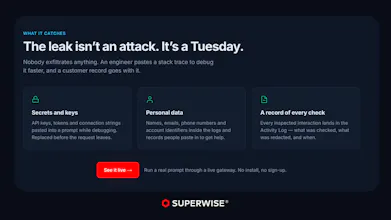
I'm John, co-founder and CPO at SUPERWISE. We've spent years in AI governance, and the pattern that finally made us build Sentinel was simple: the data that leaks into AI tools isn't leaking from some rogue app. It's people doing their jobs. A support rep pastes a customer record, an engineer pastes a stack trace with keys in it.
Sentinel runs on your own machine or network, close to where your data and apps already live. Passwords, API keys, health data and customer details are redacted before anything reaches the model, and every decision is logged so you can show what was caught.
Windows has a signed one-click installer. Mac and Linux install in a few minutes from the deployment guide. Every plan is free for 30 days, no credit card. If you'd rather see it first, the live demo runs a prompt through it with no install: superwise.ai/sentinel/demo
One question for you: what's the thing your team is most worried about pasting into an AI tool? I'll answer every comment today.
Excited to see how Sentinel from Superwise can help healthcare enterprises protect their AI engagements for both business and quality of care applications.
Hey Hunters 👋
We're the team behind Superwise Sentinel — an AI Gateway that sits in front of your LLM traffic.
Point your apps at it (no code changes) and it redacts or blocks secrets, PII, and toxic content before they reach the model — with live visibility into everything. Your prompts and responses never leave your environment; only anonymous metadata reaches us.
Up and running in minutes via CLI, Docker, Helm, or a one-click Windows app. We'd love your feedback 🙏
Sentinel tackles a huge practical challenge in AI infrastructure: security and visibility can’t realistically be built into every single application or agent as usage explodes. Centralizing PII and Secret redaction, traffic observability, and policy controls in a lightweight gateway makes perfect sense.
Headroom is especially exciting. Tool outputs and retrieved context consume tokens fast, so optimizing that data pre-inference cuts costs without sacrificing context quality. The ability to tune compression based on content type and size adds great flexibility.
Packing security, visibility, and token efficiency into one unified layer feels super pragmatic for modern AI workflows.
Really nice work on Sentinel! 👏
Honestly the thing that matters most to me about Sentinel is that nobody has to touch their code. I've seen so many "just add our SDK" security tools die during rollout because someone's script or random agent never gets the integration and just... keeps doing its own thing. Here it's just an env var pointing at the proxy, so you actually get full coverage instead of hoping every engineer remembers to wire it in. Feels like the difference between a policy that exists on paper and one that's actually enforced.
Been using Superwise Sentinel for a while now, so a few honest notes in case it helps someone deciding.
What it is, practically: it sits between your app and the model, and inspects both directions. You define guardrails — secrets detection, PII (you can scope it to specific categories rather than all-or-nothing), rudeness — and for each one pick an action: block with a custom message, or remediate by replacing the match with a placeholder. Separating input rules from output rules is the detail I'd flag, because the things you want to stop a user sending are not the same things you want to stop the model saying back.
What actually changed for us:
We stopped guessing. The dashboard shows interactions, latency, and how much got blocked vs. remediated, with the prior period alongside it, so you can tell whether a rule you added is doing anything or just adding noise.
Cost became visible. There's a separate FinOps view with token breakdown and consumption, plus token optimization. Our spend wasn't where we assumed it was.
Rollout was low-drama. Redact-instead-of-block let us turn things on without breaking the product while we tuned the rules.
Not magic — you still have to think about which rules you want and where. But it replaced a pile of homegrown regex and a lot of hoping, and that's worth something.