
StoreClaw
Grow your store profits with agents that know how to sell
2.1K followers
Grow your store profits with agents that know how to sell
2.1K followers
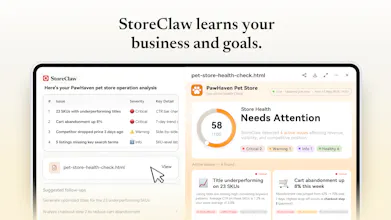
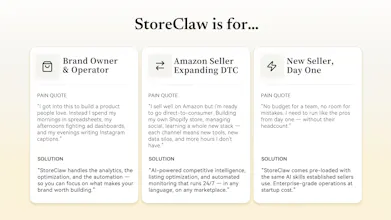
StoreClaw is the first AI commerce platform with agents that know how to sell, so you can make more money with less effort and less stress. Connect StoreClaw to your existing store and it will study your numbers, current sales figures, and growth trajectory, and then offer proactive suggestions that it can execute on your behalf — once you give it your approval. Ask StoreClaw how your business is doing any time, anywhere. Sell more with less stress: StoreClaw.




Free Options
Launch Team / Built With


Dropbox SignSimple, secure eSignatures for the way your team works.
Promoted


300 credits for a full SEO fix is actually generous. What’s the average credit usage for medium-sized stores?
@ana_popescu2 Glad you think our credit pricing is fair! For medium-sized stores, the average monthly credit usage is around 300–800 credits (covering Listing optimization, SEO, page checks, review insights, etc.). Exact usage varies slightly by product count, optimization frequency, and feature usage. For a more precise estimate, feel free to contact our support at custosmer.support@storeclaw.ai.
@ana_popescu2 Thanks a lot for your compliment! Credit consumption varies greatly based on different business demands. There is no fixed standard for medium-sized stores, most of them stay at a moderate level, and it is quite cost-effective for daily basic optimization work.
@ana_popescu2 Thanks, appreciate it.
Would love for you to give it a try with your store and see the impact firsthand. If anything comes up, my team will be happy to support along the way.
Curious about the product copy optimization side.Can it maintain an existing brand voice consistently?
@carter_garcia Absolutely. We attach great importance to style consistency. It can adjust and polish content while keeping your original brand tone and writing style steady. We are also constantly refining related style matching features for better results.
@carter_garcia Thanks Carter, and to add the mechanism to what Lena and Satomi said: when you connect a store, the agent samples your existing listings, product pages, and (if you connect them) your social and email channels, then builds a voice profile it references on every generation. Tone, vocabulary, sentence rhythm, words you avoid. New copy gets checked against the profile before it surfaces for your approval.
Where it's not magic: if your existing brand voice is itself inconsistent — which is common — the agent will surface that and ask you to pick a direction before locking the profile. We'd rather flag the ambiguity than guess.
Love seeing tools focused on actual outcomes. How customizable are the generated product copy styles?
@antonio_manuel1 Thanks a lot! The generated product copy supports full customization. You can set brand tone, writing style and target audience freely, and adjust content length and marketing focus to perfectly match your store style and different platform demands.
@antonio_manuel1 Thanks Antonio, and to add to what Satomi listed: customization works on two layers.
First, a global voice profile built from your existing content — tone, vocabulary, sentence rhythm, words you avoid. The agent matches new copy to that profile by default, so most of the customization happens passively.
Second, explicit overrides per product line or category. If your athletic SKUs need a punchier voice than your loungewear, you set that once and the agent generates accordingly. Same for length, platform-specific format (Amazon bullets vs. Shopify hero copy), and which value props lead.
AI tools that actually do things are rare.Can StoreClaw reverse or rollback changes if needed?
@james_carter35 Couldn’t agree more. We focus heavily on practical and actionable features. The system keeps full operation logs, and most regular adjustments can be undone easily. We are also constantly improving relevant rollback functions to bring users more flexible and reliable experience.
@james_carter35 Thanks James, and to add a layer to what Lena and Satomi already said: every change StoreClaw ships gets logged with a timestamp, a diff, and a one-click reversal. Most edits — listing copy, schema, descriptions, pricing — roll back cleanly in seconds.
Where it gets messier is changes that compound (a price drop that's already converted 30 orders, an inventory move that's already shipped). For those, the agent flags "irreversible from this point" before asking you to approve. We'd rather pause and explain than ship something you can't take back.
Clearly, Amazon is the part of this that interests people most. Their TOS around automated listing and pricing changes is a bit hostile and enforcement is uneven. Are you guys going through SP-API with rate-limited windows? Do operators connect via personal credentials and accept the risk?
@artstavenka1 We totally understand your concerns about Amazon compliance and safety! StoreClaw integrates exclusively via Amazon’s official SP‑API, fully adhering to their rate limits and TOS for all automated listing and pricing activities.
For more details on integration and security, feel free to contact our support at custosmer.support@storeclaw.ai.
Really like the proactive execution approach.Do the agents learn from previous approved actions over time?
@dylan_russell Thanks so much for the kind words! Absolutely — StoreClaw’s agents continuously learn from your previously approved actions, preferences, and brand patterns over time, including Listing style, pricing rules, SEO preferences, and optimization habits. It gets smarter and more tailored to your business the more you use it.
@dylan_russell Thanks Dylan, and to add to what Lena and Satomi said: the practical version of "learning over time" is that the agent keeps a memory of every approval, rejection, and edit you've made, and references it on every new recommendation. So if you've rejected three "lower price" suggestions on a premium SKU, the fourth one doesn't come up — and if you always edit listing copy to lead with the warranty, that pattern gets baked in.
What it's not yet: continuous model fine-tuning per merchant. That's a harder problem we're still working on. For now, "gets smarter" means better-informed by your history — which in practice is most of what operators actually want.
Really cool! Just a few weeks ago I recommended building a similar service to my friend! You literally read my mind))
By the way, what about integration with Google Analytics, Google Search Console, and other important marketing tools that are needed for a full understanding of issues and for high-quality recommendations?
@natalia_iankovych Haha, what a coincidence! We’ve always focused on building a data-driven optimization experience. Right now, we support integration with major marketing tools like Google Analytics, syncing key data for analysis and recommendations. We’re also continuously expanding compatibility with more popular marketing tools, strengthening data connectivity to deliver more comprehensive, precise optimization plans.
@natalia_iankovych Thanks Natalia, and that's a fun coincidence — please tell your friend hi.
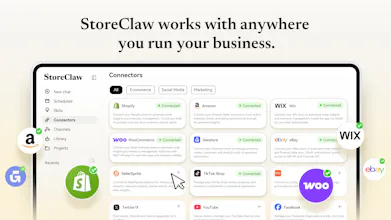
To add to what Satomi said: Google Analytics is live today (GA4, with traffic, attribution, conversions, and realtime). Google Ads is also live — ROAS, ad spend, campaign optimization. Google Search Console is on the roadmap, not shipped yet. It matters because GSC tells us what actually happened in search after the agent ships a change — without it, we're reading one side of the conversation.
Full current list of connectors is at storeclaw.ai/app/connectors. The priority order for what gets built next is shaped by which tools beta operators tell us they're already in every day. If yours isn't on the list yet, that's exactly the kind of feedback we'd want to hear.
@natalia_iankovych It feels great that our product matches your idea so well. We are working on supporting integrations with Google Analytics and more popular marketing tools. We keep optimizing data connection features, so we can gather sufficient data to provide more practical optimization advice for everyone.