
StoreClaw
Grow your store profits with agents that know how to sell
2K followers
Grow your store profits with agents that know how to sell
2K followers
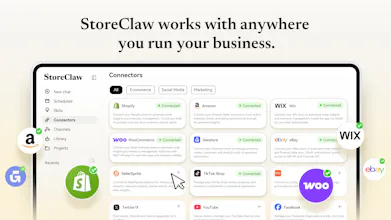
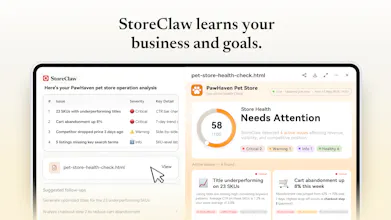
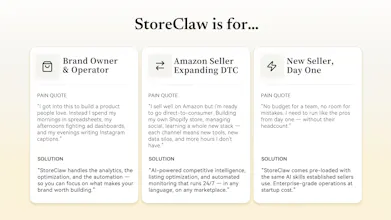
StoreClaw is the first AI commerce platform with agents that know how to sell, so you can make more money with less effort and less stress. Connect StoreClaw to your existing store and it will study your numbers, current sales figures, and growth trajectory, and then offer proactive suggestions that it can execute on your behalf — once you give it your approval. Ask StoreClaw how your business is doing any time, anywhere. Sell more with less stress: StoreClaw.




Free Options
Launch Team / Built With


BoxLite Open SourceOpen-source microVMs for AI agents, embedded in your app
Promoted


Congrats on the launch and congrats on hitting number one on Product Hunt. I have one detailed question about how StoreClaw handles post execution tracking.
When you approve a suggestion and the agent goes ahead and makes the change does it come back afterward and show you whether the change actually worked? For example if it updates product copy to improve conversion rate will it monitor that page over the next week and report back on whether the conversion actually improved and by how much?
Closing that loop between suggestion, execution and results seems really important for building trust in the platform over time. Would love to know if that tracking is already built in or if it is on the roadmap.
The approval layer design is what caught my attention — lower-risk work runs autonomously, higher-stakes changes (pricing, budget) queue for review. That's actually a sensible trust model rather than the usual "AI does everything" overclaim. What I'm wondering about is conflict resolution: if I'm running StoreClaw across Amazon and Shopify simultaneously and I approve a price change on one channel, does it automatically sync to the other, or does it treat them as separate decisions? I think your concept is quite similar to magicpin's Vera.
The approval-gating and GEO-measurement threads are well covered, so a different angle: causal attribution. Once the agent is shipping dozens of catalog and copy changes a week, how do you tell a merchant which action actually moved revenue versus seasonality or a competitor's move? Without holdout SKUs or staggered rollouts, the lift and the noise look identical, and that is usually the moment operators quietly stop trusting the agent. Are you building any control-group measurement in, or is judging impact left to the merchant?
Wondering how StoreClaw handles edge cases during high-volume events like Prime Day or major seasonal launches.
@hanzhizhang0405 Great question.During high-volume events like Prime Day or seasonal launches, StoreClaw is designed to continuously monitor store data and react based on predefined goals, historical trends, and real-time performance signals.
For important actions, merchants can also provide specific instructions or approval preferences to maintain control during critical periods.
@lena_pan2026 Thank you for your reply. And congrats on your launch!
@hanzhizhang0405
Great question — during high-volume events, StoreClaw runs with stricter guardrails, real-time monitoring, and configurable thresholds so sellers can control how autonomous it gets.
@hanzhizhang0405 Peak is where the engine shines. Listing health, inventory signals, lifecycle, content — the ops layer that usually cracks under volume keeps running clean across every channel. And the post-event diagnostics that normally take a week of post-mortems? Hours. You're already shipping the next round of optimizations while everyone else is still pulling reports.
Nice launch. Curious how StoreClaw decides what to surface first — does it prioritize by revenue impact, or by how easy a change is to execute? The "study the numbers, then act on approval" flow feels like exactly the right shape for this. Congrats to the team.
@oleksii_sekundant Thanks for the kind words! StoreClaw prioritizes suggestions by revenue impact first, and intelligently weights them by execution difficulty to show you the most profitable and actionable optimizations upfront. It’s perfectly aligned with the “study the numbers, then act on approval” workflow. Thanks for your congratulations, and we’d love your feedback after you try it!
@oleksii_sekundant Thanks — and you read the flow right. On prioritization: neither pure impact nor pure ease works on its own. Impact-only surfaces risky big swings; ease-only surfaces busywork. The engine ranks on expected impact × confidence × reversibility — so the first things surfaced are high-confidence, low-blast-radius wins that compound (listing health, content gaps, lifecycle, search visibility) before it touches load-bearing levers like pricing. Bigger swings come later in the trust curve.
Huge congrats — this space definitely needs better operational tooling. Does StoreClaw eventually learn brand-specific patterns over time, or are workflows mostly template-driven today?
@cruise_chen Thanks so much for the congratulations! StoreClaw offers ready-to-use intelligent templates today, while it continuously learns brand-specific patterns and data behaviors to adapt to your store style, Listing habits, pricing strategies and operational preferences over time. Feel free to try it out!
@cruise_chen Thanks. Honestly, both — by design. Skills give the engine a strong baseline so it's productive day one, no "wait six weeks to learn your brand" tax. Then brand-specific patterns layer in over time: voice, what's worked in your category, approval patterns, which playbooks have hit. Template-driven day one, increasingly brand-specific from there. What we deliberately avoid is making operators wait for a learning curve before the engine earns its keep.
Curious whether the platform could also be useful for offline or hybrid stores by connecting POS sales and customer trends alongside ecommerce data.
@abhinav_naithani_b24es1012_ Absolutely,it’s fully applicable.
@abhinav_naithani_b24es1012_
Great question, would definitely encourage you to try it out and see how it fits your setup, happy to explore your specific use case as well. Thanks for the thoughtful question and for checking us out.
@abhinav_naithani_b24es1012_
it works perfectly and can be applied as needed.