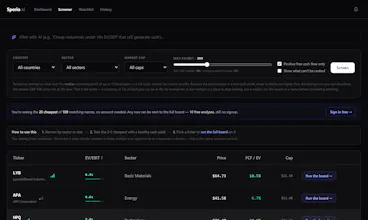
Eight AI agents research an S&P 500 company in parallel, a devil's advocate attacks the thesis, a portfolio manager decides. Valuations are computed in Python, not written by a model — and it prints n/a when the data can't support one. 10 free, no signup. It also screens on a full cycle: EV/EBIT against the median operating profit of up to 15 fiscal years, not the last twelve months.
Framer AI AgentsDesign and publish professional sites with AI
Promoted
Maker
📌
Hi PH 👋
I built Sperio because every "AI stock analysis" tool I tried was a chatbot that agreed with whatever I asked. This is the opposite. Eight agents look at the same S&P 500 company from different angles, one of them exists only to attack the thesis, and a portfolio manager with a veto makes the final call. You see the whole debate verbatim, including the quant's arithmetic step by step.
Two things I care about more than the verdict:
It computes, then argues. Earnings power value, a free-cash-flow model and the Graham Number are calculated in Python. The agents read those numbers and argue about them — they can't invent new ones.
It refuses. A free-cash-flow valuation on a bank returns n/a. A REIT gets FFO instead. Erratic EPS means no PEG. When the data can't support a method, it says so instead of printing a number anyway. That refusal list is the part I've spent the most time on.
One example: the screener ranks on EV/EBIT against the median operating profit of up to 15 fiscal years — a full cycle, not the last twelve months. It put Verizon among the cheapest names in the index at 12.8x. The board then priced the business giving zero credit for growth: $36.58 a share, against about $48 in the market. Cheap on a screen and cheap against what a business actually earns are two different statements, and you can read every step of the arithmetic behind the second one.
What it is not: there's no backtest and no performance claim. S&P 500 only, data from yfinance and SEC EDGAR. Every call is timestamped and scored against real prices in your own account, the wrong ones included — the oldest is from July 12, so the track record is five weeks long and I'm not going to dress that up.
Free to try: 10 analyses, no signup, no card.
The open question I'd most like torn apart: the valuation frame gives zero credit for growth, so every compounder looks expensive. Feature, or cop-out?