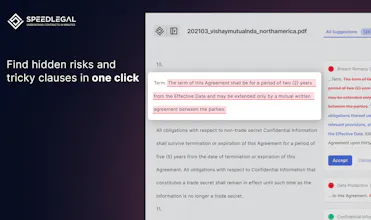
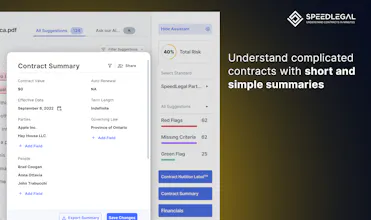
SpeedLegal is an AI tool that helps you understand and negotiate contracts better. It can quickly identify potential risks and explain complicated legal terms in simple language. SpeedLegal also gives you personalized suggestions to improve your contract.
Many of us sign at least 2-3 contracts every year. But most of us don’t really understand what we are signing.
I am one of you too.
This is why we created SpeedLegal. An AI-powered legal assistant that helps you understand contracts in just a few minutes instead of hours.
With SpeedLegal, you can:
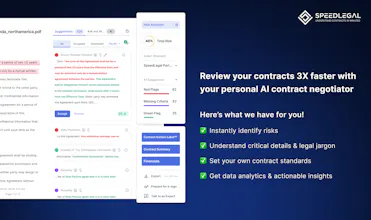
1) Review contracts 3X faster ⚡️
Imagine reviewing a complex MSA in minutes, not hours.
SpeedLegal uses AI to summarize key terms and highlight important clauses so you don’t have to read everything line by line.
2) Identify hidden risks instantly 🔎
Never miss a sneaky clause again! SpeedLegal flags potential risks and explains them to you in plain English.
3) Negotiate better terms with confidence 💪🏻
Stop feeling overwhelmed by legalese. SpeedLegal suggests clear and concise edits to help you get the best deal possible.
4) Save thousands on legal fees 💰
With SpeedLegal, you can tackle many contracts, freeing up your budget for other core areas.
SpeedLegal is perfect for:
👉🏻 Startups & Businesses of all sizes
👉🏻 Busy Professionals
👉🏻 Anyone who wants to understand their contracts without needing a law degree
I'd love to hear your thoughts and feedback on it. Give it a try!
PS - You'll get $50 worth of contract credits when you sign up on the launch day. :)
This is something I've needed since I started my professional career long ago. Since then I've adopted the mindset that I read every line of a contract. That said, some contracts still push me to do that with their length.
With this, I wonder what will be the balance of reading every line and trusting SpeedLegal. Is there an official recommendation or guarantee about it?
@bradydowling well, that depends entirely on you and you preferences! being aware of the content of a contract is always a good idea, but with SpeedLegal help you can have quickly highlighted the riskier part -and that's a big relief!
@bradydowling Good question, Brady - that's why we developed SpeedLegal Trust Score, to tell our users how we come to a specific outcome and how reliable it is.
Report
This is a GREAT use of AI. Question - we all know AI makes a lot of mistakes. How have you fought back against that issue here? Obviously wouldn't be good for that problem to crop us in contract review haha.
@trent_kennelly thank you very much Trent and great question! The secret lies on a well-performed training of the algorithm, match with having a legal team who understands how AI works
@trent_kennelly Thank you for the comment, Trent. Technology has improved massively since we started SpeedLegal (using DL classification models and NER). Now, with LLMs, we can get results that were not possible some months ago. AI is not perfect, and we should double-check - that's why we created the SpeedLegal Trust Score to explain how we provide a specific outcome and how reliable it should be for the final user.
Hi Hans,
The concept of turning the daunting task of contract review into a quick and comprehensible process is truly impressive. SpeedLegal seems like a game-changer for anyone who dreads the fine print!
How does the AI handle different jurisdictions or country-specific legal terms? I can see this being a huge asset for international businesses as well.
Congratulations on the launch, and looking forward to seeing SpeedLegal in action!
@alex_dulub Thanks, Alex - I appreciate your support. We analyze contracts in several countries, and we compare your contracts with the market standard (created by data + humans) in any specific jurisdiction. Here is a detailed article about the above https://speedlegal.io/post/how-w...
@alex_dulub@hanspaulpp The problem isn't the text itself, it's enforceability. You don't hire a lawyer because everything is fine and dandy, you hire one to minimize risk or to solve specific problems, and unless the AI is able to accurately determine under what circumstances and which part of a contract is actually enforceable, it's effectively placebo.
For example, non-competes are common, but their enforceability is actually quite limited, at least in the US. Yet, they still differ. It's easy if you have bright-line rules, but not all jurisdictions do. This is especially true in common law jurisdictions, which is every US jurisdiction outside of Louisiana. Some have a weighing test that involve multiple factors that are vague by nature (the characteristics of the new employment undertaken, distance between employers, size of market now and later, etc), some set a cutoff at length of time, some are particularly narrow in scope, almost all require actually going to court if you can't work out some sort of gardening leave (which if contracted may not be enforceable on its own). Oh, and this at least has a consistent outcome most of the time since most noncompetes are boilerplates. Many contracts are not made up of just boilerplates.
Contract law inevitably involves civil procedure. If there is a dispute, who has standing? What sort of relationship is actually present. Is there misrepresentation. Is the issue ripe, or moot? All this gets you in the court room. But if I'm negotiating with an AI, I'd take it to court every time. Because AI doesn't have attorney-client confidentiality.
I feel like I've said this a million times here on PH (so it's not you) but the current system presumes that all parties are human and legally competent in the jurisdiction. Any deviation from that is a disadvantage, one that you cannot afford. Change the laws and the balance may shift, but before that happens, well, I can almost guarantee that a tech-competent attorney will beat the AI on procedural grounds alone.
And can we just get it out of the way: smart contract is a metaphor. It can be a contract, but there are plenty of ways to deploy code onto some chain that is colloquially called a smart contract but do not and cannot form a contractual relationship with anyone or anything, period. You can deploy a library that is a shared utility - no contractual obligation there. You can deploy a contract that merely does a thing and then self-destructs. The failure to understand this (and the assumption that each EOA address corresponds to and can only correspond to a real person) has effectively caused the wrong outcome to be reached in every case involving blockchain technology that has actually reached the courts. I have an RSS feed set up just for these, actually, for federal dockets, and those are the two key errors that are made over and over again and counsel seems somehow unable to properly explain it when it's extremely easy to do so. Contracts, "smart" or not, are already agreements entered voluntarily between parties that exchanges considerations and can be enforced. "Code is law" is a pun made by someone that got lost when read by someone who knew one but not the other. It doesn't work in Chinese, for example, even if China had a working legal system. It's just a play on words that someone took too seriously. They are synonyms, but that makes it a truism. When you get down to brass tacks, the courts will determine, rightly or wrongly, if in any particular case they are the equivalent or not. Also, contracts are not enforced on the blockchain because there's no state to enforce it, that's the point of the blockchain. if mere execution is enforcement then why does the state come in to adjudicate disputes when there should not be any. The blockchain takes away a centralized authority's ability to negate an agreement between parties arbitrarily. It is undermined by the manner of attribution employed by authorities that is somehow smuggled into court as valid when really, it should not have been - the DOJ spent nearly 2 years on the Sterlingov case attempting to get around it before somehow hoodwinking the court into allowing it in. That also lacks precedential value and will be subject to challenges - in fact appeals have been filed. but will the AI know that?
Congratulations on the launch!
I've had some pretty bad experience with contracts in the last couple of years of giving service.
This tool seems super cool and beneficial.
Do you plan to support RTL languages in the future?
@afenjarb thank you very much for your feedback! The goal of SpeedLegal is to make non-legal users life easier, give it a try! As per your question, yes, we have that on our plans.
@swarna_hebb definitely! There have been so many occasions where I had to go through contracts and had no clue what it said.
SpeedLegal definitely makes the process much easier
SpeedLegal
SpeedLegal
SpeedLegal
SpeedLegal
Neurture: Quit Habits
SpeedLegal
SpeedLegal
SpeedLegal
SpeedLegal
Web3 Antivirus for Chrome
SpeedLegal
SpeedLegal
Plant ID & Disease Identifier
SpeedLegal
SpeedLegal
Boggl.ai-Your Voice AI Product Assistant
SpeedLegal
SpeedLegal
SpeedLegal
Cluing
SpeedLegal
Cluing
SpeedLegal
Cluing
SpeedLegal