
Spectral Field
Turn any track into a one-of-a-kind artwork, drawn live.
9 followers
Turn any track into a one-of-a-kind artwork, drawn live.
9 followers
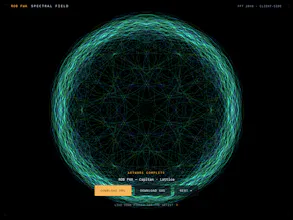
Most music visualisers just react to volume in real time — nothing to keep once the song ends. Spectral Field is different: it analyses the whole track's audio to generate one fixed, deterministic artwork — same track, same piece, every time. It runs entirely in your browser (audio never uploaded), and any piece exports as a high-res print or a pen-plotter-ready SVG. Built as a personal project by a musician who wanted his own tracks to have a visual identity — no existing tool did quite this.




How does it handle tracks that are heavily dynamic or have lots of silence — does the artwork end up feeling sparse, or does it pull from the quieter sections to fill it out?
@savakavacklmxw It actually thrives on dynamics! The algorithm is built specifically to highlight the contrasts between loud and quiet moments rather than flattening everything out. Here is how it works:
Smart Volume Normalization: When you drop a track, the engine reads the frequency spectrum and dynamically normalizes it based on the song's top 95th percentile of energy. This ensures that even ultra-quiet tracks or sparse acoustic sections still render beautiful line work, instead of disappearing into invisible strokes.
Silence Creates Delicate, Tight Geometries: The speed of the drawing pen is directly tied to real-time audio energy. During silent or minimal sections, the step-size drops to a baseline floor. The pen slows down and moves in tiny, delicate, intricate paths, creating a ghostly, tightly-knit structure.
Loud Drops Add Phosphor "Glow": Line thickness and opacity scale up with musical intensity. When a heavy drop hits, the lines become wider, bolder, and brighter.
Because it uses an additive "phosphor" blending mode, those hyper-intense sections will gorgeously overlay and illuminate the quiet, intricate webs drawn during the silences, creating a stunning visual map of the song's dynamic range.
How does it handle tracks that are really long or shift genres halfway through — does the artwork still feel cohesive or does it get messy trying to summarize too much at once?
@bnyaminmmwu Great question! It handles them by creating an evolving, layered tapestry rather than a messy "smudge." Here is exactly what happens under the hood:
Genre Shifts Create Structural Contrasts: The drawing tool (an autonomous pen) changes its behavior on a frame-by-frame basis. If a track shifts from a quiet ambient intro to heavy electronic drops, the pen will instantly transition from slow, tightly-wound, delicate lines into expansive, explosive, high-velocity geometry.
Built-in Cohesion: To prevent long or chaotic tracks from turning into a giant scribble, the engine uses a custom gravity boundary constraint. As the pen wanders, a central gravitational pull keeps it bound within a balanced, symmetrical mandala-like field.
Chronological Color Evolution: The color palette shifts slowly across time based on the song's actual timeline, while subtly blending with the current dominant pitch of the music.
Because of this, a multi-genre or long track reads chronologically like a book: you can visually trace the timeline of the song from the changing colored layers and shifting geometric patterns woven into the final piece.