
Specsight
Product observability for teams building with AI
1 follower
Product observability for teams building with AI
1 follower
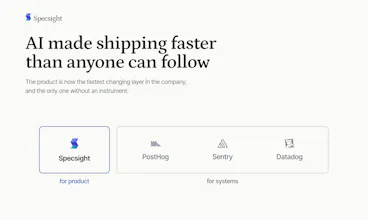
Specsight is product observability. Dev teams write code faster than ever, but the rest of the company can't keep up with what's being built. Product, sales, support and leadership spend hours every week digging through tickets and standups just to stay in the loop. Specsight monitors how the product behaves and changes at the business level, release by release. We're building a new category. In a few years, product observability will be as standard as system monitoring is today.


Free Options
Launch Team / Built With


Hey Product Hunt, I'm Ola ☺️
For years I was the human bridge. I'm an AI engineer, and at every company I've been at, I was the person people came to when they needed to know how our own product actually behaved. Support, PMs, sales - they'd ask me, I'd read the code, I'd translate. It never stopped striking me as absurd that the answer to every question about our product was sitting right there, in a language most of the company can't read.
Then AI made building radically faster, and I watched colleagues lose the ability to follow what was shipping. The gap I'd been closing by hand became structural. No person can be walking documentation for a product that changes daily. And every new tool being shipped was for engineers, nothing for the people who kept coming to me.
Specsight reads your codebase and rebuilds it one layer up - not the technical detail, the business behaviour. What every feature does for a user, how features connect, what changed in each release and who it affects. Every time your dev team ships it syncs automatically and gives the entire company a live view into your product. A single source of truth anyone can rely on.
Day to day: support answers a customer without escalating. A PM sees what actually shipped last sprint and turns it into release notes in one click. A new hire reads the product instead of booking six calls.
Biggest codebase so far is a 4,000-file production system, validated by the CTO who runs it. That scale is where other tools usually break, so it's what I built for first.
So when your team ships, how do the business teams find out?