
Sendmux
Email API for AI agents with mailboxes and provider failover
5 followers
Email API for AI agents with mailboxes and provider failover
5 followers
Sendmux is an email API for AI agents that combines real mailboxes with multi-provider outbound sending. Agents can send, receive, reply and read cleaned message content through APIs, webhooks, real-time events, MCP, SDKs and a CLI. Teams can route outbound mail through their own Gmail, Outlook or SMTP providers, with quotas, health checks and automatic failover. Pricing is usage-based, with no per-mailbox fees. Start with a free @myagent.mx mailbox.



Free
Launch Team / Built With


ClarifyThe full-stack AI CRM for modern GTM teams
Promoted
Hi Product Hunt, I’m Roshan, the maker of Sendmux.
I built Sendmux around a practical problem: giving an AI agent a real email identity still means piecing together a sending provider, a mailbox, parsing code, webhooks, logs and billing. A sending API does not give the agent a persistent mailbox state. A mailbox product does not necessarily let a team keep control of its outbound providers.
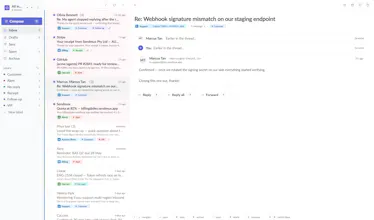
Sendmux puts both sides in one platform. Each agent can have its own mailbox, send and receive email, reply in a thread, read cleaned message content and react through webhooks or real-time events. Teams can route outbound email across their own Gmail, Outlook or SMTP providers, set quotas and weights, and fail over automatically when a provider is unhealthy.
For developers, Sendmux includes sending, mailbox and management APIs; MCP; SDKs; a CLI; and a free @ myagent.mx mailbox. Pricing is based on messages and storage, not seats or mailbox count.
I’m building this product for agent developers and platforms that need a mailbox or sending identity for every agent, customer or workspace. I’d value candid feedback: what would you need before trusting an AI agent with its email identity, and which part of the email stack is still painful for you today?