Launching today
Second Reality (1993) in your browser
Future Crew's 1993 demo, ported from source. No emulator.
6 followers
Future Crew's 1993 demo, ported from source. No emulator.
6 followers
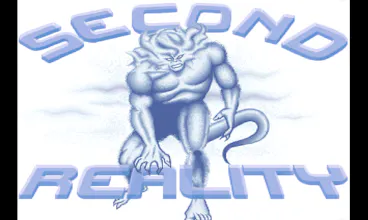
Future Crew's Second Reality, the Assembly '93 demo, ported from the original C, x86 assembly and Pascal to JavaScript. No DOS, no emulator: the original software rasterisers, VGA palette tricks and copy-protected S3M music, live in a browser. Public domain.





Hi Product Hunt.
In 1993 a group of Finnish teenagers called Future Crew wrote a program that made a 486 do things a PC was not supposed to be able to do. I saw Second Reality as a kid and could not understand how a computer was doing it. That question sent me into computers and never really went away.
Thirty-three years later I rebuilt it. Not something that looks like Second Reality. Second Reality itself, running in your browser.
What it is:
• Ported from the source Future Crew released into the public domain in 2013: the C, the x86 assembly, the Turbo Pascal, the linked objects and the shipped executables.
• No DOS and no emulator. The original is 19 chain-loaded executables; the port is one JavaScript module per part, each ported from that part's own source directory. The ship, the glenz solid and the dot tunnel are the original software rasterisers, ported line for line.
• VGA is reproduced, not emulated. The port keeps an 8-bit indexed framebuffer and does the palette lookup in a four-line shader, exactly as the DAC did. About forty lines of WebGL, no graphics library. The GPU never sees a polygon.
• Timing comes from the music, as it did in 1993. Parts ask the player where the song is instead of counting frames.
• The music is the release's own copy-protected S3M files, still scrambled on disk, descrambled at runtime by the same routine the demo used. Nobody listening would know the difference. I would.
• Much of the art was never saved as image files. It was linked into the executables, so recovering it meant reading object records, unpacking two layers of executable compression and disassembling. Not one of the 83 asset files is an image.
• The hidden part is in. The loader lists an executable it never runs, reachable only through an undocumented command-line switch. It is a message from the crew about why the demo shipped ten weeks after it won.
How it was built: by directing AI agents through the 1993 source, then checking their work against a second, independent transcription of the same source. Claude (Anthropic) wrote the port; Grok 4.6 (xAI) did a share of the grunt work, the mechanical extraction and conversion passes. Nine validators have to agree byte for byte, or one of them is wrong. A tenth plays real audio and measures picture against sound. The models are credited in the README because they did the work.
Future Crew have seen it. Pixel, who painted most of the demo's art, shared it with the rest of the crew and called it "a trip down the memory lane in a browser." He then posted a photo of the whole crew at Assembly '93, taken before the compo, that he thinks had never been published, along with the story of the power outage right before their slot: https://x.com/MiskoIho/status/2092066411699188103
Trug, who wrote the dot tunnel, the water and the mountain scroller, replied: "Congrats, and thank you for the honor." https://x.com/mtuomi/status/2092082931514609694
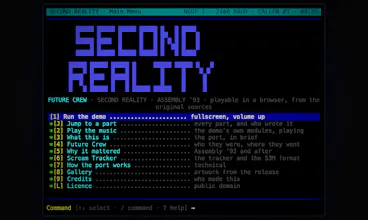
The site is shaped like the BBS you would have dialled to download it in 1993. Press 1 to run the demo, 2 for the Scream Tracker, / for a command line. Everything, including the port, is public domain. Take it, fork it, ship it.
Happy to answer anything about the port, the timing derivation, the binary archaeology, or what it was like directing agents through 1993 assembly.
@chrisstanchak amazing!