
Robynn AI
Websites that improve and heal with self-learning
451 followers
Websites that improve and heal with self-learning
451 followers
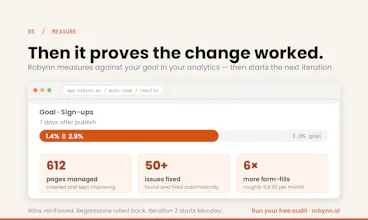
Your website starts decaying the day it ships. Broken links, stale pages, slipping rankings, invisible to ChatGPT. Robynn connects to your live site — no rebuild, no migration. It audits every page against your brand, ICP, and competitors, then proposes evidence-backed fixes. Point at any element, describe a change in plain English. Agents stage it, you approve, Robynn publishes and measures what moved in GA. Wins get reinforced. Regressions roll back. First audit is free.



Free Options
Launch Team

Context.devAPI to scrape anything for AI, 20,000+ developers trust us.
Promoted
the rollback part is what caught my eye. it'd be really cool if u could also explain why a change got rolled back so teams can actually learn from it instead of just seeing "it didnt work."
@ishm6m Yes of course
the approve-before-publish step is the part I'm skeptical of, not the audits themselves. for a small team that's already stretched thin, isn't that approval queue going to turn into a rubber stamp after the first few weeks, the same way cookie banners and permission prompts do once people get used to clicking through them. if that happens the whole you keep the judgment pitch quietly stops being true even though the UI still shows an approve button.
@omri_ben_shoham1 Yes there is that risk but the alternate of having agents directly make changes and publish on your behalf without human intervention imo is far more risky. A middle ground is it can tell you the changes it is going to make every day by email and if you dont respond it publishes on its own but still edgy tbh
As someone who is not a marketer but loves to blog and has a personal website, I would like to try Robynn to increase traffic to my blog, I am tired of Linkedin as a way to share my writings, I would like something that persists. I would like people to read my blog six months after I have posted it, and hopefully Robynn can help me with better SEO and GEO rankings, does it do that?
@mani_pande Yes, one of the goals is to increase searchability and visibility of sites.
The rollback on regressions is underrated. Plenty of tools help you publish changes but almost none actually admit when a change didn't work and undo it.
How do you decide when there's enough data to confidently label a change as a success or a regression, especially for lower-traffic websites?
Congrats on the launch! The approve-before-publish workflow and automatic rollback are especially compelling. How does Robynn isolate the impact of a specific change in GA when several factors may be affecting traffic at the same time?
This is the first pitch I've read that treats website upkeep as ongoing care instead of a one-time project.
@lanfranco_iwanaga thanks. Yes, thats the learning from working in tech for 2 decades as a former CMO/PM. Companies rarely change their website stacks by creating new ones