
Robynn AI
Websites that improve and heal with self-learning
408 followers
Websites that improve and heal with self-learning
408 followers
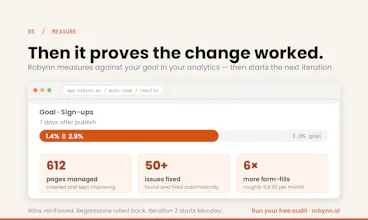
Your website starts decaying the day it ships. Broken links, stale pages, slipping rankings, invisible to ChatGPT. Robynn connects to your live site — no rebuild, no migration. It audits every page against your brand, ICP, and competitors, then proposes evidence-backed fixes. Point at any element, describe a change in plain English. Agents stage it, you approve, Robynn publishes and measures what moved in GA. Wins get reinforced. Regressions roll back. First audit is free.



Free Options
Launch Team

Framer AI AgentsDesign and publish professional sites with AI
Promoted
How does Robynn distinguish between temporary ranking fluctuations and changes that actually need intervention?
@ankur_jeswani We simply look at the web analytics metrics every 7 days.
The rollback is the part that got me. Most of these stop at telling you what's wrong, which just hands you another backlog. Closing the loop is the hard half - and once reverting is automatic you don't have to be right about any single change, just reversible. That's the whole trick.
One thing I'd want: a holdout. I run a metrics dashboard for my own stuff and got burned by this recently - download numbers are weekday-driven, weekends run 40-60% below midweek, so every Monday looks like a win and every Saturday looks like a regression. Nothing to do with anything I shipped. Without a control slice you end up reinforcing the calendar.
Congrats on the launch.
@ryan_davis23 As a former CMO I looked at a lot of dashboards that were un-actionable. My goal is to connect the analytics to action in a tight feedback loop at the web page level.
the email digest with a default-publish timeout is a fair middle ground honestly, at least it forces someone to actively ignore it rather than never seeing it at all. curious if the digest highlights which changes are lower-risk copy tweaks vs actual layout/pricing changes, since I'd guess most of the rubber-stamping risk comes from lumping trivial and consequential changes into one daily email
@omri_ben_shoham1 Not right now but we will add this. Thank you for the feedback 🙏
"Wins get reinforced. Regressions roll back." is the sentence I'd stress-test, from someone who ships an AI that takes real-world actions and has been burned by exactly this loop.
Two failure modes it doesn't cover, and neither shows up as a regression:
The first is that rollback assumes the damage is visible in the metric you're watching. The changes that actually hurt are the ones GA scores as neutral or positive. A page that converts better because it overpromises is a win in the data and a support problem six weeks later. We shipped an AI summary that told a user their call had gone well when nobody had picked up — every downstream metric looked fine, because the failure lands on someone who isn't in your funnel. If reinforcement runs on the metric alone, the loop will happily climb toward things you'd reject on sight.
The second is approval decay. "You approve" holds beautifully for the first twenty changes. Then it becomes a reflex — people approve to clear the queue, not because they read it. Now you have a human-in-the-loop on paper and an unsupervised agent in practice, and the audit trail says a human signed off, which is worse than no record at all because it looks like oversight. Nobody decides to lower the bar; it just drifts.
What worked for us was gating on reach rather than on reversibility. Irreversibility is a bad axis because it over-fires on things nobody cares about and under-fires on things that are technically undoable and genuinely ruinous. Mapping to yours: a copy tweak on a low-traffic page and a change to your pricing page are both "reversible," and they should absolutely not sit in the same approval queue. Volume of low-stakes changes is what erodes attention for the high-stakes one.
Concrete version, if useful: let auto-publish run unattended where reach is small, and reserve the human for a small number of high-reach changes — so approval stays expensive enough that people actually read it.
Curious where you've landed on this: is the approval per-change, or can users set a reach threshold above which it always stops and asks?
the rollback part is what caught my eye. it'd be really cool if u could also explain why a change got rolled back so teams can actually learn from it instead of just seeing "it didnt work."
@ishm6m Yes of course
the approve-before-publish step is the part I'm skeptical of, not the audits themselves. for a small team that's already stretched thin, isn't that approval queue going to turn into a rubber stamp after the first few weeks, the same way cookie banners and permission prompts do once people get used to clicking through them. if that happens the whole you keep the judgment pitch quietly stops being true even though the UI still shows an approve button.
@omri_ben_shoham1 Yes there is that risk but the alternate of having agents directly make changes and publish on your behalf without human intervention imo is far more risky. A middle ground is it can tell you the changes it is going to make every day by email and if you dont respond it publishes on its own but still edgy tbh
As someone who is not a marketer but loves to blog and has a personal website, I would like to try Robynn to increase traffic to my blog, I am tired of Linkedin as a way to share my writings, I would like something that persists. I would like people to read my blog six months after I have posted it, and hopefully Robynn can help me with better SEO and GEO rankings, does it do that?
@mani_pande Yes, one of the goals is to increase searchability and visibility of sites.