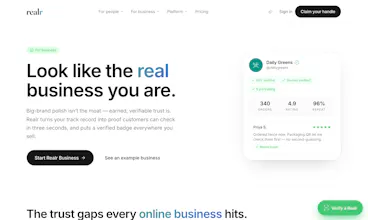
realr is a portable trust profile for the internet. Verify once — face, age, ID, photos, or your business — and share one link that proves you're real. Buyers use it before they meet or pay; Instagram sellers, freelancers & businesses use it to prove they're legit and win trust. Privacy-first: shows the claim, never your documents.
No reviews yetBe the first to leave a review for Realr.me
Maker
📌
Hey Product Hunt 👋
Online, a blue tick proves an account exists — not that the person behind it is real, or that the photos are even theirs. That gap is exactly what catfishers, fake landlords, "pay the advance first" marketplace scammers, and fake recruiters rely on.
realr closes it. You verify once — a live check confirms you're a real human, your ID confirms your identity and age, and your photos get matched to your live face. The result is one link (realr.me/yourhandle) and a QR you can share anywhere you meet a stranger: a dating app, a rental listing, a marketplace DM, a freelance gig.
Two things we care about:
• It's privacy-first. Your profile shows the CLAIM ("Real person", "Government ID verified", "Verified photos") — never your actual documents, ID number, or date of birth. You control what a stranger sees.
• It's one-time, not a subscription. Claiming a handle is free. Verifying is a one-time step. And checking someone else is always free.
And it works both ways. If you're the one people hesitate over — an Instagram seller, a freelancer, a small business — your realr proves you're a real, verified seller with a real track record, so buyers stop ghosting and actually pay. Platforms can even plug it in: "Sign in with Realr" and a trust-status API let other apps show "Verified via Realr" without building KYC themselves.
Same link, same trust — for the person checking, and the person being checked.
Would love your feedback, and happy to answer anything 🙏
Report
How does the verification actually hold up if someone just shares their link with another person who's already been verified, like is there anything tying it to the device or the person sharing it?
Report
Maker
@zcanurasltuzb Really good question — this is the thing we think about most.
The short version: realr doesn't tie trust to a device — it ties it to a face. A public profile link is meant to be shareable (you paste it in a bio, a DM, a listing), so we don't try to stop someone copying a link. We make a copied link useless for impersonation.
1. The proof is about who, shown as a face — not just "this account is verified." A realr shows the verified person's name and verified photos matched to their live face at verification. Share Aisha's realr and it still shows Aisha's face. You can borrow a verified link; you can't borrow a verified face.
2. The live QR is live, not a screenshot. When someone shows their realr, it's a short-lived QR that refreshes every ~30s and says "it's you, right now." A screenshot of someone else's QR is already expired — it can't be replayed as fresh proof.
3. The check happens before you meet — not at the door. You never have to show up to find out. The verified photos give you a trustworthy reference face, so a quick live check in the chat — a video call, a live selfie, or their live QR — confirms the person you're talking to is the person on the realr. A borrowed link falls apart there, in the DMs, while it's still cheap to walk away.
So to answer directly: there's no strong device-binding, and we're honest about that — a public URL can't be welded to a phone. What's bound is the identity: the proof only means something if you actually are the verified person, because it's anchored to a face you can check remotely, before you ever commit to meeting.
How does the verification actually hold up if someone just shares their link with another person who's already been verified, like is there anything tying it to the device or the person sharing it?
@zcanurasltuzb Really good question — this is the thing we think about most.
The short version: realr doesn't tie trust to a device — it ties it to a face. A public profile link is meant to be shareable (you paste it in a bio, a DM, a listing), so we don't try to stop someone copying a link. We make a copied link useless for impersonation.
1. The proof is about who, shown as a face — not just "this account is verified." A realr shows the verified person's name and verified photos matched to their live face at verification. Share Aisha's realr and it still shows Aisha's face. You can borrow a verified link; you can't borrow a verified face.
2. The live QR is live, not a screenshot. When someone shows their realr, it's a short-lived QR that refreshes every ~30s and says "it's you, right now." A screenshot of someone else's QR is already expired — it can't be replayed as fresh proof.
3. The check happens before you meet — not at the door. You never have to show up to find out. The verified photos give you a trustworthy reference face, so a quick live check in the chat — a video call, a live selfie, or their live QR — confirms the person you're talking to is the person on the realr. A borrowed link falls apart there, in the DMs, while it's still cheap to walk away.
So to answer directly: there's no strong device-binding, and we're honest about that — a public URL can't be welded to a phone. What's bound is the identity: the proof only means something if you actually are the verified person, because it's anchored to a face you can check remotely, before you ever commit to meeting.
Happy to hear your thought on it.