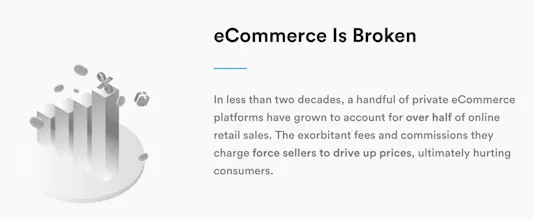
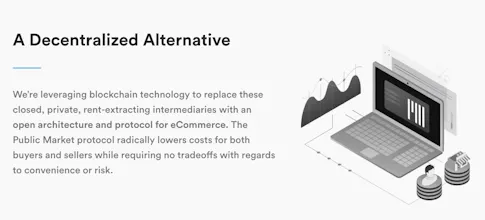
Public Market is restoring the Commercial Commons by building an open, transparent, and competitive architecture for marketplace eCommerce by leveraging blockchain technology to replace these closed, private, rent-extracting intermediaries with an open architecture and protocol for eCommerce.
This sounds really interesting, but wondering about 2 things:
1) How fraud is handled once a seller is reported as bad?
2) How is all shipping free in the US? is it required to be built into the cost of the product?
@kristofertm 1) in the short run, our marketplace (which will be launching soon at https://public.market) will broker all fraud resolution. In the longer run, we will be standing up a public insurance marketplace to make this a competitive market as well. You can see a teaser about that in this post: https://medium.com/public-market... 2) Like other marketplaces, "free" shipping is often either built into the price of the item or subsidized by the seller. We expect that competition between vendors will lead toward more subsidy, less built-in over time. And we've got some strategic partnerships in the works to help give our sellers inexpensive shipping options. Follow us on Telegram (https://t.me/publicmrkt) or Twitter @PublicMrkt to stay up to date on our progress!
@kristofertm Great questions! Our white paper will cover this more in-depth, but I'll give the high-level here:
1) The actual dispute resolution process works the same as it does on private marketplaces -- support claims are initially routed to the seller, where they are almost always resolved. In the cases where they are not, they get escalated to the dispute resolution provider. This is where the difference comes in: instead of there only being one dispute resolution provider, we've created competition at this layer of the marketplace stack. Dispute providers can compete on cost and service to ensure that there is economic efficiency in the dispute services.
Importantly in our system, sellers bear the cost of their own bad behaviors. Each seller receives a reputation score, and the better their score is, the less they have to pay for dispute resolution (think of it like fraud insurance). A good seller can get those costs down to near negligible, whereas a 'bad' seller may ultimately become 'uninsurable'.
2) See below for my answer to Alireza about how "free shipping works.
Surely the company will attempt to make money somehow, which brings to question the necessity of blockchain.
You could more easily create an e-commerce platform similar to the pre-existing options, with fees only slightly greater than the cost of running the platform if you're truly out for sellers' best interests.
Will users be required to buy your virtual currency in order to pay a (more likely than not) monthly fee?
@codyfitzpatrick No, there are no monthly fees for sellers. No commissions. No listing fees. As KJ said in an above answer, it’s an entirely different business model based around a token. The protocol itself lives within a nonprofit foundation, and gets supported by the token itself. Stay tuned for updates and the release of our product and white paper by signing up at publicmarket.io or joining our Telegram community https://t.me/publicmrkt
@codyfitzpatrick Good insights. To answer your question, no -- our tokens function as rewards points, and we don't have plans to use them to charge a monthly fee. We're building the business model around the token itself. Exactly how it works is somewhat in depth for this response, so I encourage you to sign up for our white paper when it's released (publicmarket.io).
In the meantime, Chris Dixon has a nice post investigating how these new network models can work: https://medium.com/@cdixon/crypt...
Thank you both (@wubledoo & @kjer) for the informative responses. I look forward to reading the whitepaper when it's released. I'll brush up on Chris Dixon's post in the meantime. Wishing you all the best with this venture!
Visiting this website, I am left confused as to what this actually is and why it's on PH. This looks like a platform for other developers to use for e-commerce? Or is it going to offer a way to sell directly on public market? Everything is free, which sounds good, but actually makes me wary that it will have success or stick around long term. I see blockchain, which while it might be able to be applied well in this domain (remains to be seen), I am super skeptical due to all the rampant fraud and scammy ICOs in the space.
@vlucas Fair -- i appreciate your skepticism and think it's really important, in the blockchain space particularly. I'm actually surprised to be on Product Hunt myself! We got hunted because we announced what we've been working on on Medium yesterday, it's worth a read. But we haven't launched our marketplace product yet, and that's when we really should be on here.
As to your question, we are both building a platform for developers to use to create eCommerce marketplaces (without having to get their own inventory, reputation data, or product metadata) AND we are building our own flagship eCommerce marketplace on top of that platform. Our flagship marketplace will be at public.market and host millions of products from hundreds of professional sellers. Sellers want to use it because it gives that additional sales at potentially better margins, as well as reduces their long-term reliance on private marketplaces that charge higher and higher fees and ultimately compete with them. Buyers will want to use us because eliminating commissions and replacing them with rewards tokens makes their products significantly cheaper.
But don't just believe what I'm saying -- wait for our product to be released! Hopefully we'll be hunted again at that time and you can prove it for yourself.
@vlucas We can certainly understand the skepticism-- there's a lot of hype around blockchain these days and only a few companies to date have really delivered on the promise. We are indeed building a protocol/platform that includes public inventory, reputation, and product metadata so that anyone can build their own marketplace or “storefront” on top without needing to build up two sided network effects. You can think of it like an open architecture for ecommerce, or a “Commercial Commons” if you will. We are *also* very soon be launching our own marketplace, similar to Amazon or Walmart.com (at https://public.market). You can think of our storefront as "Customer Zero" for the protocol, allowing us to "run water through the pipes" and ensure that we are perfecting it for those that adopt it to power their own storefronts.
@tostartafire agreed! We haven’t released enough information yet. Stay tuned for updates and the release of our product and white paper by signing up at publicmarket.io. It’s really something that needs to be experienced in person, and we can’t wait to release the product itself. We’re approaching this very differently than most blockchain companies by making sure we deliver a fully-functional product at the highest consumer standards, rather than asking people to rely on marketing language or hype. I think you’ll be impressed by what we deliver.
Report
Isn't this just Magento or some other Ecommerce solution with a Bitcoin (or other cryptocurrency) payment gateway? Trying to figure out what the differentiator here is when it's already possible to have a decentralized marketplace. Is Public Market just Silk Road 3.0?
Hi @rudolfolah - thanks for your question. No, we're not looking to replicate Magento or Shopify-- most of their customers are operating SINGLE seller marketplaces rather than multi-vendor marketplaces (ala Amazon, eBay, Jet.com, etc...). The latter (multi-vendor marketplaces) are what our protocol will disrupt, by taking those assets that they have held proprietary (inventory listings, catalog metadata, seller reputation, etc...) and making them freely available to anyone that has an audience. We envision a world in which anyone with a trusted online following (imagine a popular food blogger) can set up and operate an online storefront that features a curated collection of items from multiple sellers that will appeal to their audience (in this case kitchenwares, unique spices, etc...). The operator of the storefront won't have to hold or manage inventory for this curated collection, because the fulfillment will happen via the various sellers of records' own fulfillment processes.
We also will not require buyer behavior to change- our own marketplace (coming soon at https://public.market) will be "Customer Zero" for the Public Market Protocol, and will allow buyers to make purchases with credit or debit cards, and once a reputable payment processor enables us to accept crypto payments, we'll add that as well. And no, not Silk Road-like at all... our marketplace is not intended to be anonymous or to facilitate black market trade, and our own storefront will have seller policies that prohibit sale of illegal items. We encourage you to follow along as we publish more information about our plans and progress here: https://medium.com/public-market
Report
@wubledoo Thanks for the reply; it does sound like it has a lot of differentiators compared to existing ecommerce single-vendor and marketplace platforms. What's interesting is the token aspect and it sounds like that that's the real differentiator; you're acting as an aggregator of vendors/customers and simplifying access. The blockchain is to maintain a public record and for reputation (in contrast, all ecommerce vendors keep their data between themselves, individual users and the IRS or local tax authority), and the tokens are used to fundraise to maintain the nonprofit foundation that acts as a custodian. Hence why it's possible to have zero commission on each sale, you aren't acting as an intermediary, you're acting as a custodian of the market.
@behrooz_a Absolutely. There's a saying in eCommerce that "there's no such thing as free shipping". Of course someone pays! The question is really one of how you display the price -- we believe it's best for the consumer to see the full cost of the item including shipping rather than to either be surprised when it's tacked on, or have to do math in their head.
In some ways, "Free Shipping" is really a euphemism for "Shipping Included" or more positively, "no surprise fees". Thanks for your question and that important point.
@kjer Could you specify what exactly did you build already? Not just a future vision, but what is a current product! I hope it is not just a well written a "whitepaper"...
@dainiskanopa of course! We're really far along on the commission-free eCommerce marketplace product that we'll be launching soon at public.market. We'll have millions of inventory items from hundreds of professionals merchants. Importantly, Public Market allows buyers to earn previously unheard of levels of rewards tokens on purchases you'd otherwise be making on private marketplaces, all because we don't charge commissions.
CollageMo
Public Market
Public Market
Public Market
Timeline.io
Public Market
Public Market
Timeline.io
Public Market
Public Market
Public Market
Public Market
Public Market
Public Market
Public Market
Public Market
Truecaller
Public Market
Daily Insight
Public Market