
Probuck Workspace
AI-powered document intelligence, built for accuracy.
11 followers
AI-powered document intelligence, built for accuracy.
11 followers
Probuck Workspace is a set of tools — Document Explorer, Chatbot, Agentic Workflows — that grounds AI in your documents, turning them into a reliable, queryable knowledge base. Most tools stop at a chatbot. Probuck delivers reliable, repeatable, auditable answers and lets you build them into multi-step agentic workflows that run across your documents — autonomous document processing, not just Q&A. Enterprise capability, without the six-figure price tag or six-month rollout.


Hi Product Hunters 👋
Launching Probuck Workspace (probuck.ai) after two years of research and months of building. Wanted to share the "why" because it's the part I think most AI document tools get wrong.
The problem that started it all
I was working with various AI tools to implement document processing use cases that involved the extraction of accurate numerical data points, primarily from unstructured PDFs. All the tools I tried were implementations of standard vector RAG — chunk the document, embed the chunks, retrieve the nearest neighbours, ask an LLM to write the answer.
That approach is fine for "summarise this contract" or "what does this report say about X". It falls apart the moment you ask "what was the value in row 14, column 3 of the cost table on page 47?" — because by the time the model sees the data, the table has been flattened into a soup of text, the row and column relationships are gone, and the LLM is essentially guessing which number belongs to which label. In a construction progress report or a financial statement, "guessing" is not an acceptable failure mode.
So I built the thing I wanted.
What Probuck actually does differently
Two ideas, and everything else falls out of them.
1. Structure-preserving ingestion. Files are processed page-by-page by a vision model that reads the document the way a human would — preserving table structures, layout, and contextual relationships that traditional text extraction destroys. Tables are stored in their original row/column form rather than flattened into text, and every document is then dual-indexed for both semantic vector search and full-text keyword search. That dual index is what makes the rest possible.
2. A hybrid retrieval engine with a deterministic-first fallback chain. Three AI-driven strategies, one chain, full auditability:
DTR — Deterministic Table Retrieval. An AI agent identifies candidate tables and the correct row/column mapping, then a purely programmatic lookup pulls the cell value. No further AI involvement in the value itself.
GTR — Guided Table Retrieval. Same agent-driven table + mapping identification, but an AI-guided retrieval step handles the read. Used when DTR struggles with inconsistent formatting, merged cells, or poor scan quality.
RAG — Retrieval Augmented Generation. Advanced hybrid search feeds the most relevant content to an AI agent to generate a free-text answer. Best for prose questions and as a semantic fallback when table retrieval fails.
Queries traverse the chain in that order, and every step is logged — retrieval attempts, candidate tables, matched rows/columns, chosen strategy, final answer. Every answer is traceable, every retrieval step inspectable. You can defend the workings, not just the number.
There's also a fourth mode — PRT (Programmatic Table Retrieval) — for repeatable extractions where you already know the exact row/column wording. No LLMs, no fallback, zero token usage. It's the "audit-grade, no AI risk" option for workflows that run the same lookup across hundreds of documents.
Where it fits in a workflow
Three surfaces sit on top of that engine:
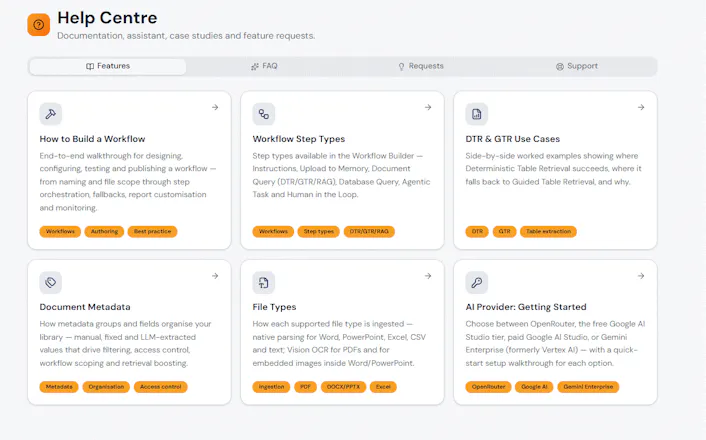
Document Explorer — browse, search, and manage the library with custom metadata, groups, and granular access controls.
Document Chatbot — natural-language Q&A over your corpus, grounded in citations, with the full diagnostics trail behind every answer.
Agentic Workflows — build multi-step workflows and run them across hundreds of documents, combining hybrid retrieval for the structured/auditable steps with generative AI for the reasoning steps.
All three can optionally pull in live external data (web, APIs, direct file uploads into context) when a workflow needs to blend internal document intelligence with something fresher.
The stack, for the Product Hunt-curious
TanStack Start on Cloudflare Workers, Supabase (Postgres + pgvector) for the database and RLS, Cloudflare R2 for object storage, BYOK for the AI layer (Google AI, Vertex AI, or OpenRouter) so customers control their spend and their data residency. Paddle as merchant of record for global billing.
What I'd love from the Product Hunt community...
Feedback. On the website (probuck.ai) — especially the "does this actually explain what it does" question. On the product itself. Is it useful? What does it do well? What could be better?
Introductions to anyone drowning in unstructured PDFs (finance, legal, construction, research).
War stories from anyone else who's tried to make RAG behave deterministically — I'd genuinely like to compare notes.
Happy to answer anything about the architecture, the BYOK decision, or why I think pure-vector RAG is a dead end for numeric extraction.
Thanks for reading 🙏
Tried it with a stack of messy contracts and the Document Explorer actually pulled the right clauses on the first pass. The agentic workflows feel like the real differentiator though, since I could chain a few steps together without babysitting each one.
Introducing Probuck Workflows
Only need workflow automation? Try our zero-retention edition — Probuck Workflows.
· Build and run agentic workflows on files you upload. Citations and audit trails on all answers
· Documents processed, then deleted – nothing kept
· No Document Explorer, no Chatbot, no document library
· Team seats for joint access to workflow and history
Zero retention. Just fast, intelligent document workflow automation.
See pricing: https://probuck.ai/pricing