
Powabase
Build AI apps with Postgres, RAG, and agents
919 followers
Build AI apps with Postgres, RAG, and agents
919 followers
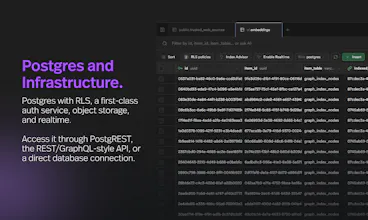
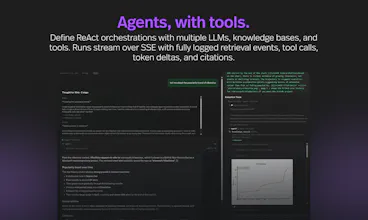
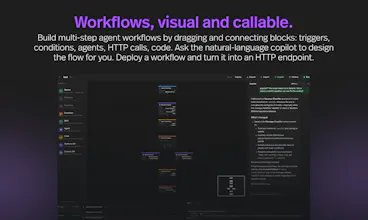
Powabase is a backend-as-a-service for AI-native applications, combining Postgres, RAG, agents, memory, workflows, and automation primitives in one platform. It helps agencies and in-house IT teams build new AI apps or add AI automation to existing products without stitching together fragmented infrastructure. Designed to work seamlessly with modern coding agents, Powabase helps teams ship faster while building more robust, token-efficient systems.



Free
Launch Team / Built With


Tines The single, secure environment for agents, apps, and automations.
Promoted
How much time took to do it?
@mykola_s The idea came to us about a year ago. We started building by using Supabase's open source codebase as a baseline, then extended it with our own unique features and integrations.
Powabase is not a "static" solution. Given how quickly the AI landscape shifts, we need to be moving with it as well. So the work is never truly finished. Going from Supabase open source baseline to v1 of production-ready Powabase took about 6-7 months.
Shoutout to Claude Code. It's a great coding assistant that really helped us accelerate the development process.
This is very interesting. If this integrates deeply with Claude Code / Cursor workflows I can see dev agencies adopting it really fast. Congrats on shipping.
@roopreddy We are a dev agency ourselves so hopefully what we built could be useful for other dev agencies and teams looking to build their own AI-native SaaS.
We believe the future will be one with hyperpersonalized SaaS solutions enabled by coding agents and robust infra frameworks like Powabase.
@roopreddy currently we have comprehensive API docs and cookbook examples which can guide coding agents on how to build on Powabase and use our AI features. In the future we plan to add MCP and Agent Skills to make it even easier. For the standard Supabase features such as auth or storage, we have the same API, so it'll be familiar to coding agents. We also allow direct connection to the underlying Postgres DB. This is an area in which we'll be continuously improving - I myself been building client apps on Powabase with Claude Code
@1lastshot thanks for your support! Powabase essentially evolved out of GPT-trainer. We learned a lot of lessons when we tried using it as an AI agent platform for other apps we were building (e.g. AI-powered document processing) but ran into pain points with GPT-trianer's focus on chatbots. We're hoping that Powabase, "backend we wish we had", will help others build AI-native apps too, and we'd love to hear more about what apps you may be trying to build!
@1lastshot Following up from @michael_t_chang , Powabase was inspired by the fact that many users of GPT-trainer requested direct API access to the backend. Instead of stripping out the backend from an end-user SaaS, we thought it was best to properly address the root demand and build a dedicated AI-native BaaS instead.
Thank you for your positive feedback and encouragement!!
@1lastshot Thanks so much! Genuinely want to hear what you're building. Drop me a line about your use case and I'll help you set it up on Powabase.
@xin_chen17 Really appreciate that and I'd love your feedback on my idea. Is there a good way to contact you? The GPT Trainer support email, or Powabase discord, other...? Product Hunt doesn't have a DM option anymore.
@1lastshot We have a Discord at: https://discord.gg/k8W2A9KRtc. I am there most of the time so please feel free to drop in and ask any questions!
This launch caught my attention on the leaderboard for its positioning. May I ask how this compares architecturally to LangGraph Platform or Mastra?
@zerotox Good question. The key difference is scope. LangGraph Platform and Mastra are primarily orchestration frameworks, they give you great primitives for defining agent workflows, state, and control flow, but you still bring your own backend: vector store, database, auth, file storage, etc., and wire it all together yourself.
Powabase folds that whole stack into one backend. You get the orchestration layer (RAG, ReAct agents) plus the data and infra layer (vector storage, metadata, retrieval) integrated out of the box, so there's far less glue code between your agent logic and the services it depends on.
I love working with @Powabase and @hunter_powabase for Ryden Solutions, the first & leading life science continuous quality and compliance assessment platform simulating FDA inspectors at all times while also becoming more efficient. Hunter's platform has simplified development and set us up for long term success as we scale.
@hunter_powabase @adam_foresman Thank you so much! Ryden Solutions has been one of the most rewarding projects we've worked on — what your team is building is exactly the kind of regulated-industry use case that pushed us to take Powabase's primitives seriously. We have learned a ton from working with you. Excited to keep building together!
@adam_foresman Thanks a lot Adam! Your positive feedback made my day!
Powabase is perfect for use cases like Ryden. It's ideal for anything document-heavy and privacy-sensitive.
Looking forward to our continued partnership!
Congrats team, loved this tool.
Are you also planning to add some usecase over the website?
@vrijraj Yes, absolutely. In fact, we already have a good collection of Powabase serving as the backend for a number of projects that we undertook ourselves.
The biggest one to date is a legal research platform made for the Swiss branch of a global insurance company. The goal is to index the entirety of Swiss laws and court decisions to serve as evidence / advisory for eventual claims processing automation.
We are offering a "free MVP build" program where Powabase's forward-deployed engineers build an MVP on top of Powabase for companies with concrete app ideas, for free. You can find out more here: https://powabase.ai/free-mvp/
Would love to hear more about what apps you may be trying to build!
@vrijraj thanks for your support!
@vrijraj Really appreciate the support, means a lot! Curious what you're working on — if you tell me a bit about it I'm happy to help you get it running on Powabase.
We tried building something similar internally and realized maintaining embeddings, ingestion and orchestration pipelines becomes a full-time job. Good stuff.
@syed_shayanur_rahman It is a lot of heavy lifting for sure. The process gets even more frustrating as you build it out for multiple clients over and over.