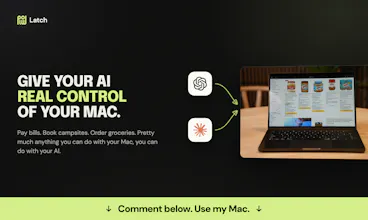
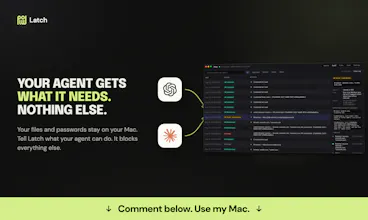
Safely give your agent real control of your Mac, while keeping your data local on your machine. With Plow Latch, pretty much anything you can do with your Mac, you can do with your AI.
Hey, Plow, get a big tub of açai or ice cream for the whole team for dessert. They’ve worked hard and absolutely deserve it! Consider it a delicious investment in team productivity!
Report
The case for this got concrete for me recently. I run several agent sessions on one machine and they share a browser. One session was completing an OAuth flow, and a different session's routine page read picked the single-use authorization code off the localhost callback page. Nothing malicious, no prompt injection, just two agents with the same ambient access and no boundary between them.
That is the part I think gets missed about scoping. The threat model is not only a rogue agent, it is two well behaved agents that both legitimately have the credential in reach.
Does Latch scope per session or per agent identity? Concurrent sessions on one Mac are where I would want the boundary to sit.
Hey, Plow, get a big tub of açai or ice cream for the whole team for dessert. They’ve worked hard and absolutely deserve it! Consider it a delicious investment in team productivity!
The case for this got concrete for me recently. I run several agent sessions on one machine and they share a browser. One session was completing an OAuth flow, and a different session's routine page read picked the single-use authorization code off the localhost callback page. Nothing malicious, no prompt injection, just two agents with the same ambient access and no boundary between them.
That is the part I think gets missed about scoping. The threat model is not only a rogue agent, it is two well behaved agents that both legitimately have the credential in reach.
Does Latch scope per session or per agent identity? Concurrent sessions on one Mac are where I would want the boundary to sit.