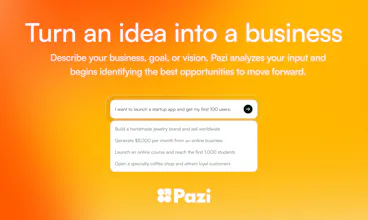
Pazi is an AI team for that idea you keep coming back to — a book, a shop, an app, a skill you want to sell. Tell Pazi what you're trying to do and it builds a team of agents around your idea and starts making things happen: a website, first outreach, content, the next step. Every time you come back, something has moved. You stay in control; your team does the rest alongside you, one real step at a time. Like vibe coding but for business operations.
No reviews yetBe the first to leave a review for Pazi
@zvonimir_sabljic1 looks awesome, congrats! How "enclosed" to does the concept need to be meaning what happens if the idea is reliant on super complex third-party API systems etc.?
@millwiller Thanks, Will! The idea doesn’t need to be fully enclosed. Pazi’s agents can work with external APIs and request credentials when access is needed. The more bespoke the integration, the more guidance and validation it may require initially—but if the API is documented and programmatically accessible, it should generally be a good fit.
"get me customers." is a much more meaningful outcome. I am wondering how your agents access live external data today? Feels like autonomous business agents become more useful once they can reliably pull market signals🤔
@luki_notlowkey Exactly—that’s how we think about it too. Today, Pazi’s agents can use live web search and connect to external APIs when access is provided, using those signals for research, competitor monitoring, lead discovery, and planning. Making that market awareness increasingly continuous and reliable is a major part of where we’re taking Pazi.
Report
awesome execution congrats 👏 @zvonimir_sabljic1 for shipping. qq how do you handle the context window limits when a business runs for 6 months and the agents have hundreds of past experiments to remember?
@vikramp7470 Thank you! Each agent has its own memory, alongside shared memory for the entire business. Both are continuously updated with relevant decisions, experiments, and results, so we don’t need to fit six months of raw history into every context window—the agents pull in the context that matters for the task at hand.
Report
Since Pazi is running similar business loops across many ideas, how do you think about transferring knowledge between users? For example, if one agent discovers that a particular outreach strategy consistently works, does that make every other agent smarter while still preserving user privacy?
@tarqiya_forgah Great question. Today there’s no knowledge transfer between users—or even between separate businesses on the same account. Each business and its agents are fully isolated, so strategies, results, and private context never carry over automatically. We may add opt-in sharing between businesses within one account, while cross-account transfers would most likely remain manual through export and import.
Report
Congrats on the launch, Zvonimir. The "build vs. figure out what to actually do with the business" gap is something I run into constantly between managing a dealership and building a property management site. Honestly, half the challenge isn't the build itself, it's knowing which of the ten things I could do next actually moves the needle. Curious how Pazi decides what to prioritize when someone gives it a vague goal like "grow the business." Does it ask clarifying questions first or just start proposing a plan?
@andre_ajemian Thanks, Andre! It does both: the COO learns about your business and asks targeted questions when important context is missing, then turns a vague goal like “grow the business” into concrete opportunities. You choose which opportunity to pursue and can discuss the tradeoffs with your COO before the team starts executing.
Report
Congrats on the launch! "Every time you come back, something has moved" is the angle that sold me — most agent tools still just sit and wait for prompts. Curious how you balance agents acting autonomously vs. asking for approval on things like outreach?
@alex_tomilin Thanks, Alex! The main boundary is the opportunity itself: you choose what the team should pursue, then the agents work autonomously within that direction. They come back when they need access, credentials, or a decision that materially changes the plan. For outreach, you can shape the approach upfront and then let the team execute without approving every individual step.
@alex_tomilin You are welcome! Let me know if you have any other questions
Report
the research-grounded-vs-guessed question above is the one that matters most imo - when Brave search and browser-use turn up conflicting pricing data for the same niche, does the agent reconcile the sources or just pick one and run with it?
@sabber_ahamed Good question. Today, this is handled by the agent’s reasoning rather than a deterministic reconciliation layer. It should compare sources, favor recent primary data, and surface meaningful conflicts instead of silently choosing one—but it isn’t foolproof, and we’re continuing to improve it.



@zvonimir_sabljic1 looks awesome, congrats! How "enclosed" to does the concept need to be meaning what happens if the idea is reliant on super complex third-party API systems etc.?
Pythagora
@millwiller Thanks, Will! The idea doesn’t need to be fully enclosed. Pazi’s agents can work with external APIs and request credentials when access is needed. The more bespoke the integration, the more guidance and validation it may require initially—but if the API is documented and programmatically accessible, it should generally be a good fit.
@leon_ostrez Got it, nice! That's super helfpul.
Pythagora
@millwiller Thank you for the support!
AgentKey
Pythagora
@luki_notlowkey Exactly—that’s how we think about it too. Today, Pazi’s agents can use live web search and connect to external APIs when access is provided, using those signals for research, competitor monitoring, lead discovery, and planning. Making that market awareness increasingly continuous and reliable is a major part of where we’re taking Pazi.
awesome execution congrats 👏 @zvonimir_sabljic1 for shipping. qq how do you handle the context window limits when a business runs for 6 months and the agents have hundreds of past experiments to remember?
Pythagora
@vikramp7470 Thank you! Each agent has its own memory, alongside shared memory for the entire business. Both are continuously updated with relevant decisions, experiments, and results, so we don’t need to fit six months of raw history into every context window—the agents pull in the context that matters for the task at hand.
Since Pazi is running similar business loops across many ideas, how do you think about transferring knowledge between users? For example, if one agent discovers that a particular outreach strategy consistently works, does that make every other agent smarter while still preserving user privacy?
Pythagora
@tarqiya_forgah Great question. Today there’s no knowledge transfer between users—or even between separate businesses on the same account. Each business and its agents are fully isolated, so strategies, results, and private context never carry over automatically. We may add opt-in sharing between businesses within one account, while cross-account transfers would most likely remain manual through export and import.
Congrats on the launch, Zvonimir. The "build vs. figure out what to actually do with the business" gap is something I run into constantly between managing a dealership and building a property management site. Honestly, half the challenge isn't the build itself, it's knowing which of the ten things I could do next actually moves the needle. Curious how Pazi decides what to prioritize when someone gives it a vague goal like "grow the business." Does it ask clarifying questions first or just start proposing a plan?
Pythagora
@andre_ajemian Thanks, Andre! It does both: the COO learns about your business and asks targeted questions when important context is missing, then turns a vague goal like “grow the business” into concrete opportunities. You choose which opportunity to pursue and can discuss the tradeoffs with your COO before the team starts executing.
Congrats on the launch! "Every time you come back, something has moved" is the angle that sold me — most agent tools still just sit and wait for prompts. Curious how you balance agents acting autonomously vs. asking for approval on things like outreach?
Pythagora
@alex_tomilin Thanks, Alex! The main boundary is the opportunity itself: you choose what the team should pursue, then the agents work autonomously within that direction. They come back when they need access, credentials, or a decision that materially changes the plan. For outreach, you can shape the approach upfront and then let the team execute without approving every individual step.
@leon_ostrez got it, thanks for clarification!)
Pythagora
@alex_tomilin You are welcome! Let me know if you have any other questions
the research-grounded-vs-guessed question above is the one that matters most imo - when Brave search and browser-use turn up conflicting pricing data for the same niche, does the agent reconcile the sources or just pick one and run with it?
Pythagora
@sabber_ahamed Good question. Today, this is handled by the agent’s reasoning rather than a deterministic reconciliation layer. It should compare sources, favor recent primary data, and surface meaningful conflicts instead of silently choosing one—but it isn’t foolproof, and we’re continuing to improve it.