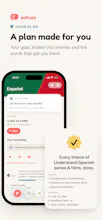
A coach that builds a plan around your goal and measures your pronunciation (it hears th vs s). Coached sessions, hands-free spoken role-play, tap-any-word explanations β and it remembers your recurring mistakes. No streaks, no points. iOS, six languages.
No reviews yetBe the first to leave a review for oohula
Maker
π
Hi, I built oohula over the last three months because I stalled at beginner level and couldn't find what I actually wanted: a coach that builds a plan for me personally, and helps me pronounce like a native.
What makes it a coach: you tell it what you want the language for β following series without subtitles, ordering in restaurants, work calls β and it builds a plan around that goal at your level, then reworks it as you progress. Pronunciation is genuinely measured, not self-graded: say it out loud and it hears which sound slipped, down to th vs s, and explains the fix in your native language. And it remembers you between sessions β a German speaker's "since three years", a Spanish speaker's ship/sheep merger become tracked patterns your sessions drill. There's hands-free spoken role-play where the coach stays in character, and you can tap any word (or ask anything) mid-conversation β every new word becomes a flashcard in your personal dictionary.
iOS only for now (the engine is server-side, so Android/web are on the path). Six languages, eleven locales. I'd love to hear where it works and where it doesn't β especially from people who plateaued at intermediate and quit the gamified apps.
Report
the "measures pronunciation, not self-graded" bit is the actual differentiator here, most apps just take your word for it. curious how it handles accent variation though - if I'm learning Spanish, is it grading me against one specific reference accent (say, Castilian) even if my goal is understanding Mexican Spanish, or does it adapt the target sounds to the variant I actually care about? a "th vs s" distinction that matters in Spain would just be a false correction for someone aiming at Latin American Spanish.
Report
Maker
@galdayanΒ Great question β this exact case is handled, and it's why the accent choice is part of setup, not a display preference. When you add Spanish you pick the variant (Spain or Latin America), and that choice keys the whole measurement path: your recording is scored against reference pronunciations generated for that variant, and the checker only flags contrasts that exist in it.
So on a Latin American track, the reference for "cerveza" is /s/ β seseo is the target, and saying "s" is simply correct. /ΞΈ/ only becomes the reference if you explicitly chose Spain. Same mechanism for English (US or UK) and Portuguese (Portugal or Brazil).
One honest limit: "Latin America" is a single pan-regional reference, so it doesn't model country-level differences (Mexican vs Rioplatense, say). And the grader is deliberately conservative β every flag is confidence-gated, and it stays silent rather than mark a sound it isn't sure about, because one false correction costs more trust than ten missed ones.
Report
Ah now this is a cool idea. We've all used the big name language learning apps right? The main challenge I've always faced is the app's idea of what I need to learn first. And that doesn't really help me actually speak the language when I go abroad... so I get bored and stop using it! I see I can set myself a goal and the app creates a plan for that. This sounds promising and more real life relevant. The important question (for me at least): when is Android coming?
Report
Maker
@martin_tannerΒ thank you, martin! yes, that's the core premise. additionally, the coach adapts the plan to your individual level, and involves while you make progress. i would love your feedback once you have the chance to try it out. though, i guess, that would need android then. give me some more weeks, android and web is definitely on the roadmap.
Report
does it actually catch softer mistakes like word stress or intonation, or only the discrete sounds like th vs s?
Report
Maker
@vedat1z7jΒ in production, we judge discrete IPA differences. right now, i am fine-tuning on stress marks and the results are very promising, should go live next week. i reckon judging on intonation will come later on as it is a bit more challenging to get it right.
the "measures pronunciation, not self-graded" bit is the actual differentiator here, most apps just take your word for it. curious how it handles accent variation though - if I'm learning Spanish, is it grading me against one specific reference accent (say, Castilian) even if my goal is understanding Mexican Spanish, or does it adapt the target sounds to the variant I actually care about? a "th vs s" distinction that matters in Spain would just be a false correction for someone aiming at Latin American Spanish.
@galdayanΒ Great question β this exact case is handled, and it's why the accent choice is part of setup, not a display preference. When you add Spanish you pick the variant (Spain or Latin America), and that choice keys the whole measurement path: your recording is scored against reference pronunciations generated for that variant, and the checker only flags contrasts that exist in it.
So on a Latin American track, the reference for "cerveza" is /s/ β seseo is the target, and saying "s" is simply correct. /ΞΈ/ only becomes the reference if you explicitly chose Spain. Same mechanism for English (US or UK) and Portuguese (Portugal or Brazil).
One honest limit: "Latin America" is a single pan-regional reference, so it doesn't model country-level differences (Mexican vs Rioplatense, say). And the grader is deliberately conservative β every flag is confidence-gated, and it stays silent rather than mark a sound it isn't sure about, because one false correction costs more trust than ten missed ones.
Ah now this is a cool idea. We've all used the big name language learning apps right? The main challenge I've always faced is the app's idea of what I need to learn first. And that doesn't really help me actually speak the language when I go abroad... so I get bored and stop using it! I see I can set myself a goal and the app creates a plan for that. This sounds promising and more real life relevant.
The important question (for me at least): when is Android coming?
@martin_tannerΒ thank you, martin! yes, that's the core premise. additionally, the coach adapts the plan to your individual level, and involves while you make progress. i would love your feedback once you have the chance to try it out. though, i guess, that would need android then. give me some more weeks, android and web is definitely on the roadmap.
does it actually catch softer mistakes like word stress or intonation, or only the discrete sounds like th vs s?
@vedat1z7jΒ in production, we judge discrete IPA differences. right now, i am fine-tuning on stress marks and the results are very promising, should go live next week. i reckon judging on intonation will come later on as it is a bit more challenging to get it right.