AI made writing code cheap. Testing, maintenance, and security still dominate the bill. oma holds agents to that half: a Stop hook keeps the session open until your tests pass, artifact checks and an independent judge verify the work, and 30+ deep skills cover the rest. All plain files in your repo.
Framer AI AgentsDesign and publish professional sites with AI
Promoted
Maker
📌
AI made writing code nearly free, so most agent harnesses now race to make the model type faster. Scaffold the app, close the ticket.
Writing was never the expensive part. Testing, maintenance, and security are where the cost of software always lived, and AI didn't move that. It gets worse on a large codebase: an agent will tell you "tests pass, all criteria met" because saying so costs it nothing, and nothing inside that same session can contradict it.
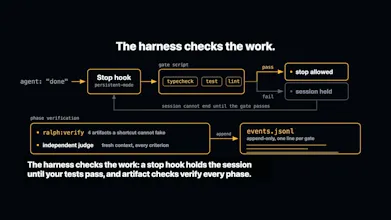
oma makes the claim checkable instead of taking the agent's word for it.
Verification. A Stop hook refuses to end the session until your project's own typecheck, test, and lint scripts exit 0. `oma ralph:verify` looks for the artifacts a real run must leave behind: phase records, the plan, a separate QA agent's result, a separate refactor agent's result. If they're missing, the phase didn't happen, whatever the summary says. An independent judge with a fresh context rechecks every criterion on every loop, including the ones that already passed, because that is where regressions hide. Every verdict lands on an append-only event log you can audit later, and per-session token and spawn budgets warn you before the next agent burns your quota.
Memory and navigation. L1 memory recalls the current session. L2 memory runs as a real background service (launchd, systemd, or Windows Task), so decisions survive a model switch from Claude to Codex or a week away from the project. Serena gives agents LSP-backed, symbol-level code navigation instead of blind grep, and oma reaps idle language servers so a long session doesn't leak RAM.
Skills as a system. One audit found prompt injection in 36% of marketplace SKILL.md snippets. Every oma skill ships a resource tree on a shared runtime with progressive disclosure; oma-observability alone carries 33 reference files, and oma-backend has per-language templates for Python, Node, and Rust. The installer is path-contained and rejects any skill that tries to write outside your project. Beyond code there are skills for market research, design systems, slides, video, voiceover, and security scans.
Everything lives in .agents/ as plain files in your repo, so your team can bend every gate, charter, and rule to its own standard. I also open-sourced fullstack-starter (github.com/first-fluke/fullstack-starter), a real project wired to oma, because harnesses love to claim quality and rarely show a live example.
Try it: curl -fsSL https://raw.githubusercontent.co... | bash
(auto-installs bun, uv, and serena), or bunx oh-my-agent@latest if you already have them. I'd
love your feedback.