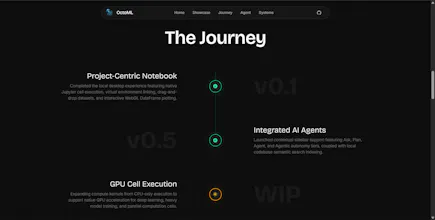
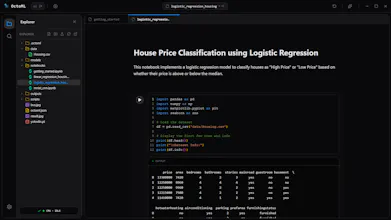
OctoML is a project-centric, deeply AI-integrated desktop notebook IDE designed entirely from the ground up for modern data scientists. It runs locally as a blazing-fast Electron application, combining the exploratory power of Jupyter notebooks with the speed, AI intelligence, and project management of a modern IDE.
No reviews yetBe the first to leave a review for OctoML
Maker
π
Hi Product Hunt! π
I'm Ragul, the creator of OctoML.
The idea for OctoML came from a frustration I faced almost every day as a data scientist. My workflow was scattered across Jupyter notebooks, VS Code, terminals, file explorers, documentation, and AI chat windows. Every time I asked an AI for help, I had to explain my project all over again because it only understood the current prompt-not the project itself.
That led me to ask a simple question:
What if AI understood the entire project instead of just a single notebook or conversation?
That's the core idea behind OctoML.
OctoML is a project-centric, AI-native desktop notebook IDE built specifically for data science and machine learning. Instead of treating notebooks as isolated files, it understands your notebooks, project structure, datasets, execution history, and workspace context, allowing the AI to collaborate more like a real teammate than a chatbot.
Building it has been a fascinating journey. One of the biggest challenges wasn't creating the notebook editor-it was designing an agent runtime that can reason about an entire project, use tools intelligently, and work naturally inside a notebook environment. There's still a long roadmap ahead, but this launch is an important milestone toward that vision.
I'd genuinely love to hear your feedback. Whether you're a data scientist, ML engineer, researcher, or someone who spends their day in notebooks, I'd love to know:
What slows you down in your current workflow?
What would you want an AI-native notebook IDE to do?
What features would make you switch?
Thanks so much for checking out OctoML and supporting the project! Your feedback will directly shape what we build next. π
Report
Curious how you handle large datasets or models that need GPU access since it's an Electron app running locally β does it tap into local CUDA setups out of the box or do I need to wire that up myself?
Report
Maker
@erdalm26540Β At the moment, OctoML uses your existing local Python environment, so if you've already configured CUDA-enabled libraries like PyTorch or TensorFlow, your notebooks can use them just as they would in Jupyter. Native GPU-aware kernel management and execution are something I'm actively working on and are on the roadmap. The goal is to make GPU workflows much more seamless without requiring users to manually wire everything together. I'd love to hear how you're currently managing GPU-based notebook workflows
Curious how you handle large datasets or models that need GPU access since it's an Electron app running locally β does it tap into local CUDA setups out of the box or do I need to wire that up myself?
@erdalm26540Β At the moment, OctoML uses your existing local Python environment, so if you've already configured CUDA-enabled libraries like PyTorch or TensorFlow, your notebooks can use them just as they would in Jupyter. Native GPU-aware kernel management and execution are something I'm actively working on and are on the roadmap. The goal is to make GPU workflows much more seamless without requiring users to manually wire everything together. I'd love to hear how you're currently managing GPU-based notebook workflows
https://octoml.dev/#timeline