Launching today

Navige
Cut AI agent costs and control runaway spending
152 followers
Cut AI agent costs and control runaway spending
152 followers
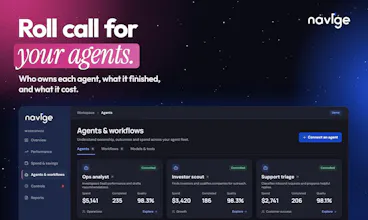
Navige uses Sufficiency Intelligence to cut AI agent costs while work runs. It sends suitable requests to smaller models, caches repeated reads and trims bulky tool results. If unsure, it keeps your chosen model. Set budgets, catch runaway loops and approve sensitive actions. See costs and savings by job, with estimates clearly labelled. Watchtower is free forever. Preview changes before switching controls on.




What happens if Navige doesn't recognise the model I am using? Does it show zero cost?
@anandhu_mj No, we don't do that. If we don't know what a model costs, we simply mark it as unpriced. Same goes for external tools where pricing hasn't been set up. We'd rather be upfront about what's missing than give you a number that looks accurate but isn't.
Why should I put another service between my AI agents and their providers? Isn't that another thing that could break?
@german_merlo1 Fair question. Since Navige sits in the middle of your agent calls, we know reliability is important. You can set how you want failures handled, depending on what the agent is doing. A simple information request is very different from a financial transaction. I would say start with Watchtower, try it with your own agents and see how things work. Once you are happy, you can turn on the other controls.
Excited to be hunting Navige today!
What caught my attention is how simple the idea is: most of what AI agents do doesn't need the most expensive model, but that's usually what runs every single call. Navige gives each task just the model it needs, only ever moves calls down, and falls back to your original model if a smaller one fumbles. Plus budgets, approval holds and a kill switch for when an agent goes off the rails.
What I love most is Watchtower, which is free forever and just shows you what it would save before you switch anything on. Congrats @sojimathewj and the team on the launch! Let's go!
@kate_ramakaieva Thank you so much for hunting Navige today! You have probably explained what we do better than I have in the last 13 months! 😂 Really appreciate your support and for being part of our big day. Means a lot to all four of us. Let’s go!
@sojimathewj @kate_ramakaieva
After many months of building, breaking things, fixing them, and occasionally wondering why something worked yesterday but not today, Navige is finally live on Product Hunt! As the person leading engineering, it is pretty exciting to see all those late nights turn into a real product. Huge credit to @sojimathewj , @akhil_shajahan and @shameeh for this crazy journey together.
We have built something we genuinely believe can change how people use and pay for AI. Now comes the fun part, seeing what the world thinks!
Give Navige a spin. Would love your feedback, especially from fellow builders!
@akhil_shajahan @shameeh @alanantony
Love the Watchtower idea. Seeing what it would change before turning it on feels like the right way to build trust. How do you catch cases where a cheaper model gives a plausible but slightly worse answer?
@mia_qiao That is exactly the tricky part, because a cheaper answer can look right but still miss something important. If we cannot be confident about the quality, we would rather stick with the original model than save a few pennies.
The cost breakdown by job sounds genuinely useful. It's hard to optimize AI spending when everything shows up as one big bill.
@arjunmeera132 Exactly, A big bill doesn't really tell you what's going on. We want people to see where their money is going and what they can actually do about it.
Showing what Watchtower would change before switching it on feels like a sensible place to start. Also appreciate the distinction between measured savings and estimates, that makes the numbers much easier to judge.
@oleksii_sekundant Thanks! That is exactly why we built Watchtower this way. We want people to see what Navige could do for them before making any changes. And yes, keeping actual savings separate from estimates is important. Nobody wants to make decisions based on numbers that look great but might not hold up in reality!