
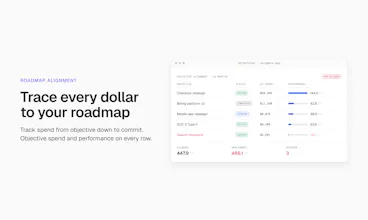
Navigara connects AI coding performance directly to your engineering roadmap. Analyzing code like a senior engineer to prove real capacity gains, Navigara tracks exact costs per roadmap item, isolates off-roadmap waste, and identifies maintenance burn. Cut spend further by automatically routing routine CRUD tasks to low-cost models without sacrificing quality. Connects in minutes via Git history, JIRA/Linear, and any AI coding license for spend.




Free Options
Launch Team

AWS Startup AdvisorPersonalized AWS guidance that meets you where you’re already building
Promoted
nice
@mykola_svystun Thank you Mykola 🤗
Cost per roadmap item is the number finance keeps asking for and nobody has, so this lands. One thing I'd push on: off-roadmap work isn't always waste, half the refactors that save a codebase never had a ticket. How does Navigara tell exploration apart from actual burn?
@yelyzaveta_kibets Thank you for the amazing question… You should still run experiments and refactor your application… Just create an initiative that shows that. Why hide these important things? We are just showing that the development team did something without a connection to the roadmap or a ticket, and as you are mentioning, this is not necessarily bad, but it is important to explain why it was necessary to do this.
@bachel Making the unplanned work visible as its own initiative is a better answer than trying to guess intent automatically. If a refactor has to be explained rather than hidden, that is a healthier habit anyway. Thanks for taking the question seriously.
@yelyzaveta_kibets That's the whole thesis. We don't guess intent, we just make sure someone had one.
how do you account for engineers who spend significant time mentoring, designing systems or unblocking teammates?
@croft_benjamin Fair question. ETV reads merged code, so mentoring and unblocking don't show up as the mentor's output. They show up in the team's.
That's why we report at team level by default. If a staff engineer spends a week unblocking four people, their personal ETV drops while the team's rises. Read individually that looks like underperformance. Read at team level it looks like what it is.
ETV also splits into Features, Maintenance, Fixes, Tests and Documentation, so architecture and cleanup work that does land in the repo isn't scored as zero for not being a feature.
Mentoring is an input. Shipped roadmap is the output. A senior who spends a week unblocking four people has a bad ETV week and a team that shipped more, which is the trade you want to see. If the mentoring is happening and the roadmap still isn't moving, that's a finding, not an accounting error.
@odeth_negapatan1 Thanks for your comment! We've been using Navigara on every retrospective of our own team, and while I led teams for years, this type of feedback completely changed how I approach leadership. When I talk to engineers I know outside of Navigara, they always think they pull the whole team while thinking everyone else is slacking. Understanding that (1) the raw output matters, but (2) where it goes matters much more just makes all those discussions so much easier. We are able to correct our behaviors within days, instead of months. There's no need for "micro-management", because you can easily manage your own work by looking at your Navigara profile and seeing where your effort could've mattered more.
Love that Navigara reframes AI spend around actual roadmap value shipped instead of raw token usage, that is the metric engineering leaders have been missing.
@ilko_kacharov Appreciate that.
Raw token usage tells you what you spent, not what you got.
One CTO told us it felt like Billy Beane from finding out his best hitter was the guy nobody rated. Same team, different call.
We are the analyst in the corner with the laptop. We do not run the team. We hand you the number nobody else is looking at, then get out of the way.
In baseball that number was on base percentage. Everyone paid for home runs and batting average because those look good on a highlight reel. On base percentage was boring, cheap, and correlated with actually winning.
Ours is roadmap delivery. Not commits. Not story points. Not hours logged. What share of your engineering spend, human and AI, turned into work that was on the roadmap.
Most teams have never seen that number. The first reaction is usually a long pause.
What stood out to me is that Navigara isn’t just asking, “How much AI are we using?” but the much more important question: “Is that AI actually moving the product forward?” Connecting engineering spend with real roadmap progress could give teams a far clearer picture of where AI is creating leverage—and where it’s just creating more activity. Very thoughtful approach.
@tanjum Thanks for your comment! Exactly, this is what we do internally every 2 weeks. Check what we delivered, where did our resources go, and how can we navigate the next 2 weeks better. It's just that we don't need to anchor our dicusssions in opinions and feelings, because Navigara gives us the numbers.
Tying AI infrastructure costs directly to feature roadmaps is super practical for engineering leaders tracking ROI. Great launch!
@thisiskp_ Thank you so much. We have been working on this every day for a long time. When the COO of Uber complained about token spend, how they burned through their token budget in four months, and how the link between spend and ROI was not there yet, we were screaming that we had built the link.