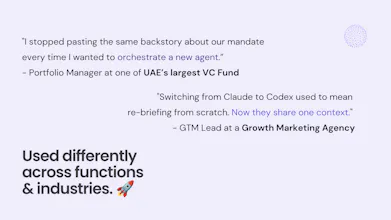
For knowledge workers orchestrating a dozen AI agents. 🧠 Your context never sits still: decisions shift, deals move, priorities change by the hour. Yet every new chat starts blank, and no agent knows what the others already worked out. N71 gives them one shared context that stays current, connect your tools and it maintains a living knowledge graph they read from over MCP, updated the moment anything changes. Ask any agent anything, and it's already caught up. 🔗
No reviews yetBe the first to leave a review for N71
How does the knowledge graph stay accurate when multiple agents are writing to it at the same time, and is there any conflict resolution if two tools update the same fact differently?
@hacer358337 Good question, and it's the one that separates a real context layer from a shared notepad. N71 doesn't do naive last-write-wins. Every write carries its own provenance, so the graph always knows which agent or source wrote a fact, when, and off what evidence. When two tools assert something different about the same thing, both land as versioned claims with their own confidence rather than one silently clobbering the other. The more recent, better-evidenced one becomes the current view, but the prior state stays diffable in temporal memory. And when the disagreement actually matters, the graph surfaces it as a contradiction to reconcile instead of burying it. Writes also pass through a governance broker that authorizes and logs every call, so concurrent edits stay ordered and auditable.
Report
How does the knowledge graph stay accurate when multiple agents are editing overlapping context at the same time, do you handle conflicts or does the latest write just win?
@asiyeergvev7sj Not latest-write-wins, that's the shortcut we deliberately avoided. When agents edit overlapping context, each write is stamped with its source, timestamp, and a confidence score, and they get reconciled by evidence rather than by whoever happened to write last. A fact backed by three sources outweighs a one-off assertion. The current view reflects the strongest, most recent evidence, but nothing gets destroyed. The earlier versions stay in temporal memory so you can see exactly how something changed, and real conflicts surface as contradictions to review.
Report
one thing I didn't see covered yet - what happens to everything the graph already learned from a tool once you disconnect it. does that history get purged from the graph, or does it stick around as context agents can still read even though the source is gone and can no longer be re-verified
@galdayan hey man, super interesting problem across the entire memory and context space because of how interconnected entities relationships and evidence can be.
We benchmarked this at n71.ai/benchmarks
Although we scored best in class on deletion and absence, it’s not perfect yet and so we are continuing to evaluate new ways to solve the problem!
Report
Hooked up my main work chat and a few agents, and the shared context finally clicked for me. It is wild seeing answers pull in what I sorted out three tabs ago without me copy pasting anything.
@erdal224209 This is exactly the moment we hoped people would hit. That thing you sorted out three tabs ago is still in the graph, so any agent you point at it just knows, no copy paste, no re-explaining. Thanks for hooking up your setup and giving it a real run. Curious what else you end up throwing at it.
Report
how does it decide what counts as a meaningful change worth updating the graph for vs just noise from tool activity
@utku1074360 the signal vs. Noise was a really interesting problem when we were building this out.
With some things it was super clear eg. Marketing emails
With others not clear at all.
We got to a point where I’d say we’re about 95% of the way there in terms of ensuring we remove noise from your graph but it’s not a singular algorithm or process.
Without going into proprietary detail the process of promoting a raw data point to an entity is quite extensive and we built a scoring algorithm that combines deterministic signals with LLM extracted signals across over 14 categories.
But things can still slip! So instead of treating this as a ingestion problem we think about it at every stage of our pipeline meaning down stream synthesis evaluates and continues to trim de-duplicate merge and clean up any noise on an ongoing basis.
I’d love for you to try it out yourself and let me know what you think. In the MEME benchmark measuring memory systems over dynamic data the noise to signal ratio is 35k tokens to 1k tokens and we managed to top it best in class.
All the details can be found at n71.ai/benchmarks
Report
Plugged it into my setup and asked three different agents about a project update — they all pulled the same current info without me retyping anything. The shared context piece feels like the actual unlock.
@yusuf1wl3 Three agents, one current answer, zero retyping. That's the whole thesis in a sentence, thank you for putting it that way. The shared context layer is the unlock, and it compounds, the longer you use it the more every agent has to draw on. Really glad it clicked for you.
Report
plugged it into my notion and slack setup and it actually kept track of shifting priorities without me babysitting it, which is more than i expected from a context layer.
@enolacunkgli Notion plus Slack is a great pairing to test it on, since that's where priorities actually shift day to day. Keeping track without babysitting is the bar we set for ourselves, so it means a lot that it cleared it for you. Appreciate you plugging it in and reporting back.
How does the knowledge graph stay accurate when multiple agents are writing to it at the same time, and is there any conflict resolution if two tools update the same fact differently?
N71
@hacer358337 Good question, and it's the one that separates a real context layer from a shared notepad. N71 doesn't do naive last-write-wins. Every write carries its own provenance, so the graph always knows which agent or source wrote a fact, when, and off what evidence. When two tools assert something different about the same thing, both land as versioned claims with their own confidence rather than one silently clobbering the other. The more recent, better-evidenced one becomes the current view, but the prior state stays diffable in temporal memory. And when the disagreement actually matters, the graph surfaces it as a contradiction to reconcile instead of burying it. Writes also pass through a governance broker that authorizes and logs every call, so concurrent edits stay ordered and auditable.
How does the knowledge graph stay accurate when multiple agents are editing overlapping context at the same time, do you handle conflicts or does the latest write just win?
N71
@asiyeergvev7sj Not latest-write-wins, that's the shortcut we deliberately avoided. When agents edit overlapping context, each write is stamped with its source, timestamp, and a confidence score, and they get reconciled by evidence rather than by whoever happened to write last. A fact backed by three sources outweighs a one-off assertion. The current view reflects the strongest, most recent evidence, but nothing gets destroyed. The earlier versions stay in temporal memory so you can see exactly how something changed, and real conflicts surface as contradictions to review.
one thing I didn't see covered yet - what happens to everything the graph already learned from a tool once you disconnect it. does that history get purged from the graph, or does it stick around as context agents can still read even though the source is gone and can no longer be re-verified
N71
Hooked up my main work chat and a few agents, and the shared context finally clicked for me. It is wild seeing answers pull in what I sorted out three tabs ago without me copy pasting anything.
N71
@erdal224209 This is exactly the moment we hoped people would hit. That thing you sorted out three tabs ago is still in the graph, so any agent you point at it just knows, no copy paste, no re-explaining. Thanks for hooking up your setup and giving it a real run. Curious what else you end up throwing at it.
how does it decide what counts as a meaningful change worth updating the graph for vs just noise from tool activity
N71
Plugged it into my setup and asked three different agents about a project update — they all pulled the same current info without me retyping anything. The shared context piece feels like the actual unlock.
N71
@yusuf1wl3 Three agents, one current answer, zero retyping. That's the whole thesis in a sentence, thank you for putting it that way. The shared context layer is the unlock, and it compounds, the longer you use it the more every agent has to draw on. Really glad it clicked for you.
plugged it into my notion and slack setup and it actually kept track of shifting priorities without me babysitting it, which is more than i expected from a context layer.
N71
@enolacunkgli Notion plus Slack is a great pairing to test it on, since that's where priorities actually shift day to day. Keeping track without babysitting is the bar we set for ourselves, so it means a lot that it cleared it for you. Appreciate you plugging it in and reporting back.