
MosMos
Voice writing that works before, during, and after meetings
729 followers
Voice writing that works before, during, and after meetings
729 followers
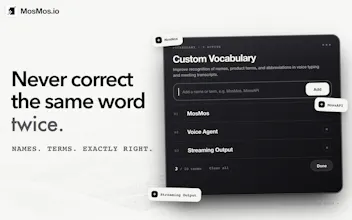
MosMos goes beyond voice dictation by turning both individual thoughts and group conversations into usable writing. Speak naturally in any app, get fast and accurate text in the style you choose, or ask MosMos to search the web for current information. Its personal glossary remembers specialized terms after you add them once. In multi-speaker meetings, it tracks precise timestamps, distinguishes speakers, and creates structured notes, summaries, decisions, and action items for easier follow-up.



Free Options
Launch Team

Atlassian LoomShow, don't just tell with Loom
Promoted


Can I change a reminder’s time by voice after creating it, or would I edit it in Records?
@qi_xiao2 For now, you can change the reminder’s time manually in Records. Editing an existing reminder by voice isn’t supported yet, but that’s a great idea for making the flow smoother. Thanks for suggesting it!
If I ask a follow-up in Ask MosMos, does it keep the context from my previous question?
@minahu Not yet—Ask MosMos currently treats each question independently, so you’ll need to include any relevant context when following up. We plan to add multi-turn conversations so you can keep going without repeating yourself. Thanks for asking!
Hey Team, great product! I'd give it a go, but I'm too much of a typer, specially for code and such but great concept, something that translates directly into what you want👌 I wonder how you are handling potential partnerships and the b2b side of things with other apps. Thanks a lot!
@matheus_paranhos1 Thanks for the interest and kind words! Totally get preferring to type, especially for code. Our team is considering partnerships and B2B opportunities, though we don’t have specifics to share just yet. We’ve also got more features planned, so stay tuned!
I really love the direction!
The coding use case clicks for me well. Explaining a requirement out loud is a natural way to give an agent the context it needs.
Hope you can win today's launch! Good luck!
@cheng_ju1 Thanks for the kind words and for cheering us on today! 🙌
That coding workflow is a big part of why we built MosMos: moving between agent windows and talking through requirements without losing the train of thought.
Which coding agents do you usually work with?
@lego260312 I use Codex and Claude Code at the same time.
@cheng_ju1 Nice! You can switch to the Codex or Claude Code window, press Fn, and speak your next instruction.
Would love to hear how that feels in your workflow.
@new_user___2572026b0e111b149ce38cb Thanks, Robin! We wanted MosMos to work equally well for quick voice input and longer meetings, without giving up personalization or privacy. Really glad those details stood out 🚀
@new_user___2572026b0e111b149ce38cb Thanks so much! 🚀 Those features are meant to work together—the vocabulary you add for everyday dictation also carries into meeting transcription and notes. Glad the idea resonates with you!
The coding use case really clicks for me. Explaining a requirement out loud is a natural way to give an agent the context it needs.
@carolyn_lyn It’s one of my favorite workflows too—voice makes it much easier to give coding agents full context without breaking focus.
@carolyn_lyn Carolyn, thanks for coming!
It’s often the “why” and the edge cases that take the longest to type out. Making it easier to talk through that context was a big motivation for us when building MosMos.
I can see researchers getting value from the speaker labels and timestamps when reviewing interviews with several participants.
@wayne66 Thanks, Wayne! For interview work, what would save you the most time after transcription: finding quotes, comparing themes, or drafting a summary?
@wayne66 Yes!Knowing who said something and when also makes it easier to check a summary against the discussion. For interviews, that context can matter just as much as the quote itself.