
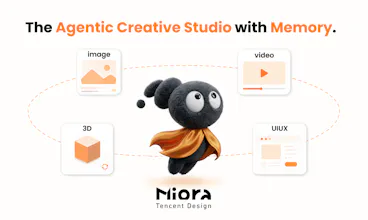
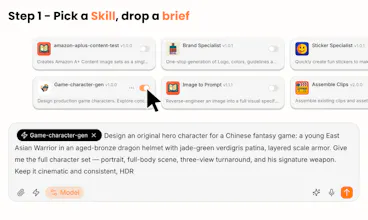
Not another AI image tool. Miora is an Agentic Creative Studio with Memory. Bring one idea, generate multimodal assets on one editable canvas, turn auto-built memory into a reusable Skill, then create more, always true to your taste. One person, a whole creative studio.


Free Options
Launch Team

Customer.ioAutomate Messaging Everywhere — Startups Get 12 Months Free
Promoted
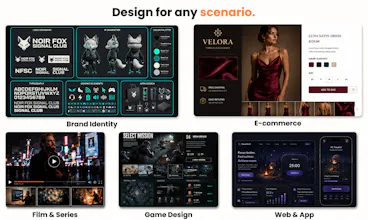
A full campaign pack from one brief sounds powerful. How does the agent maintain consistency when assets are produced by different underlying models for image, video, UI, and 3D?
@luke_pioneero Yeah this was the thing that kept us up honestly. The trick is the consistency doesn't live in the models, it lives one layer above them. Whatever you upload (your product, palette, the rules) gets pinned in memory and pushed into every step as hard constraints, so it doesn't matter if it's the image model or the video one doing the work, they're all drawing from the same anchor. Otherwise, you just get 5 pretty assets that look like 5 different brands
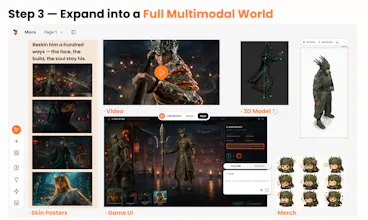
@luke_pioneero Building on Sherina's point about the memory anchor, this is exactly why we don't just generate everything simultaneously in a black box. The workflow in Miora usually starts with establishing a strong core asset—like a key visual or character design. Once you approve that node, its specific stylistic DNA gets locked into the agent's memory. When you then branch out to generate a video or a 3D object, the agent isn't starting from scratch; it's explicitly referencing that approved anchor node. The underlying models might be different, but they are all forced to obey the same master reference you established.
@luke_pioneero Great question. The key is that consistency lives above the individual models. The agent keeps the approved direction, character traits, references, and design rules as shared context, then adapts them for image, video, UI, or 3D generation.
Different models may produce the assets, but the agent is carrying the same creative intent across them.
@luke_pioneero That’s exactly the problem we’re trying to solve. Traditional AIGC workflows often treat every generation step as isolated, so creators have to repeat the same context, prompts, references, and decisions at every node.
Miora Creative Agent is designed to carry that context forward across image, video, UI, and 3D. You don’t need to restate everything each time. It should feel less like operating a pipeline, and more like collaborating with someone who already understands what you’re trying to make.
agent memory that builds up your brand's taboos automatically is exactly the piece every creative team has been re-teaching AI tools weekly. one persistent brand doc miora actually reads is the win.
real q: is the specialist chain visible when an asset ships? like can i see "script agent to storyboard agent to illustration agent" with what each contributed? asking because when brand teams review, they want to point at the specific step that went wrong, not the whole pipeline.
@thenameisarian Great question! That's actually a direction we're really excited about.
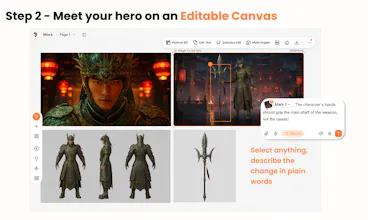
Today in Miora's Free Canvas, you can see assets evolve step by step and jump in to edit any part of the process directly on the canvas, so creation feels collaborative rather than like a black box.
You're also not locked into a fixed workflow, you can decide which specialist handles which task and shape the process as you go.
@thenameisarian Right now you can already see what each specialist is doing in the conversation and follow how assets evolve on the canvas.
So if something breaks, you can usually tell where it broke.
The more explicit review workflow you're describing for brand teams isn't there yet, but honestly that framing is kind of brilliant 😄
"Don't blame the whole pipeline, point to the step that broke" is probably a better way to describe the problem than we've been doing internally.
Mind if we steal that? Would love to keep you posted as we build toward it.
@thenameisarian Because a real Agent is handling the task, you don’t need to worry about the process being hidden. Unlike traditional pipelines or workflows, you can freely direct the Agent or ask questions to get exactly what you need!
@thenameisarian btw, memory is just the one of many exciting features coming to Miora. We’re rethinking creative generation around a true Agent, with the goal of transforming how people create while dramatically lowering the barrier to entry. Much more is coming.
One of the most interesting launches today, especially the anchor-node idea. Wondering...you approve a core key visual, branch video, UI and 3D off it, then perhaps realize the anchor was slightly wrong...Does fixing the anchor re-propagate to everything downstream? Is each child a manual redo? Great work anyway!
@artstavenka1 Great question! Updating the anchor doesn't automatically redo everything. The new direction can be saved into Miora's memory, and creators can choose which downstream assets they want to regenerate.
We believe creative teams should stay in control — sometimes you want the whole system to evolve, and sometimes you only want to adjust one branch~
@artstavenka1 Thanks for the kind words and the brilliant question, Art! The short answer is that we deliberately avoid forced auto-propagation. Miora is designed as a fluid canvas rather than a rigid, top-down workflow tool. There isn't a strict "downstream"—you can use node A to generate node B, and then actually use B to iterate back on A. We built it this way because we strongly believe that in the age of AI generation, the "human touch" found in step-by-step fine-tuning and curation is more precious than ever. Blindly auto-updating child nodes often destroys those intentional creative choices. However, if you do want that automated pipeline effect for a specific task, you can easily save your mature process as a reusable Skill!
@artstavenka1 You touched on a really important point. Miora isn’t designed as a traditional node-based workflow where changing one upstream node mechanically re-runs everything downstream.
The anchor is more like a shared creative direction: the approved intent, visual logic, references, and decisions behind the work. If you later realize the anchor is slightly wrong, you can update that direction, and the agent can help carry the correction into related assets across video, UI, or 3D.
The goal is not automatic destructive re-propagation, but intelligent revision. The agent should understand what changed, what needs to be adjusted, and what can stay intact, more like working with a creative teammate than operating a pipeline.
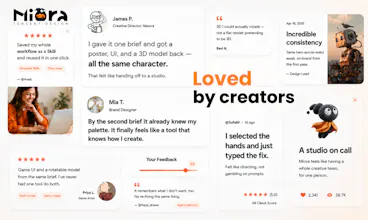
Tried Miora this morning and the memory turning into a reusable Skill thing actually worked, my color choices carried over to a totally different asset without me redoing anything. The editable canvas feels way less chaotic than juggling tabs.
@cnurettin33910 Thanks so much for trying Miora and sharing this!
This is exactly what we’re building toward and really glad the Skills and editable Canvas are helping make your workflow smoother.
Would love to see what you create with Miora and hear any feedback as you keep exploring!
@cnurettin33910 Thanks so much for trying Miora out, Nurettin! We strongly believe that maintaining context shouldn't require manual copy-pasting, and organizing thoughts shouldn't feel like a tab-management simulator. Really glad to hear the canvas is bringing some visual sanity back to your creative process!
@cnurettin33910 This is exactly what we heard a lot during our beta. Once people use Miora for a while, it becomes hard to go back to one-off generation or node-based workflows.
The value really shows up when creative decisions start carrying across assets naturally: colors, style choices, brand rules, references, approved directions. You spend less time rebuilding context and more time actually shaping the work.
@cnurettin33910 Memory is just the one of many exciting features coming to Miora. We’re rethinking creative generation around a true Agent, with the goal of transforming how people create while dramatically lowering the barrier to entry. Much more is coming.
I like that memory is not presented as magic. Being able to inspect, edit, and add rules makes it feel more like a creative system the user owns instead of hidden personalization controlled by the model.
@orman_canida This is exactly how we think about it. Every rule in memory is visible and editable — you can add "always keep this brand color," remove something that's drifting, or correct how it reads your style. It's a creative system you steer, not hidden personalization you inherit. Appreciate you calling that out
@orman_canida Exactly. The biggest problem with "magical" black-box memory is that it actually works against you when you need to change directions.
In real studio production, you frequently need to partially or completely overturn a previous design. An invisible memory will just keep interfering and messing with your new concepts. Making memory editable means you can instantly clear out the old rules and pivot without fighting the AI. Thanks for seeing exactly what we were aiming for!
@orman_canida Yes! We don’t want memory to feel like hidden magic. In Miora, memory is organized automatically in the background, almost like how the brain consolidates thoughts while dreaming at night.
But the important part is ownership. Users should be able to inspect it, edit it, add rules, or correct the agent when needed. Creative memory should be something the user can shape, not something silently controlled by the model.
@orman_canida Memory is just the one of many exciting features coming to Miora. We’re rethinking creative generation around a true Agent, with the goal of transforming how people create while dramatically lowering the barrier to entry. Much more is coming.
the memory-into-Skill part is the interesting bit for me - if my taste shifts mid-project, does the skill drift with new edits or does it lock in from the first few briefs and need a manual reset?
@sabber_ahamed To clarify, a Skill in Miora functions as a shareable SOP rather than a continuously evolving memory. It doesn't automatically drift in the background as you continue to edit, nor is it rigidly locked to your very first brief. Instead, it acts as a snapshot. When you finally decide to save a process into a Skill, the system looks at your entire workflow and summarizes the final, matured style you landed on at that exact moment. If your taste shifts again later in the project, you would simply save that new, updated process as a fresh Skill.
@sabber_ahamed That’s a really sharp question. The distinction is deliberate: Skills stay fixed, so they do not quietly drift as your taste changes. If you want to update one, you can ask Miora to revise it, but that is an intentional change.
Memory is different. It can evolve with the current context and your history, correcting itself as it learns more about your preferences. You can also edit it directly whenever you want.
@sabber_ahamed Memory and skills is just the one of many exciting features coming to Miora. We’re rethinking creative generation around a true Agent, with the goal of transforming how people create while dramatically lowering the barrier to entry. Much more is coming.
Many tools can generate variations. Fewer can remember why a direction was approved and carry it into another medium
@jody_l_wyatt That's exactly the problem we're interested in. Generating options is getting easier fast. Remembering why a decision was made feels much harder and much more valuable.
@jody_l_wyatt Totally agree. The hard part isn't creating more options, it's maintaining creative consistency and delivering reliable, aligned outputs over time. That's something we've been thinking deeply about, and it's the kind of creative memory we're building with Miora.
@jody_l_wyatt Spot on, Jody! You’ve highlighted exactly why the traditional linear chat interface often fails real creative work. When you try to iterate inside a chat box, the AI tends to get stuck in a rut, getting progressively worse as you give it more feedback, and you can't even roll back to a previous good version. That’s why we built Miora on an infinite canvas—it lets you freely branch, compare, and merge different nodes. When you finally approve a specific direction, our memory layer captures the exact WHY behind your choice, acting as a stable anchor that carries that approved style seamlessly into other mediums like video or UI without losing the essence along the way.
@jody_l_wyatt Exactly. The goal isn’t just more variations, but carrying the approved intent across mediums. That’s where memory becomes really useful.
@jody_l_wyatt Memory is just the one of many exciting features coming to Miora. We’re rethinking creative generation around a true Agent, with the goal of transforming how people create while dramatically lowering the barrier to entry. Much more is coming.