Excellent app to catalog media of any type, whether it be video, audio, or images. Developer is constantly adding new features based on user suggestions/requests in a very timely fashion. I like the app's ability to handle different metadata to tag media with. Privacy concerns are addressed accordingly: app does not resort to interactions with outside AI sources for its information gathering to verify data stored on a customer's local storage and the app is thankfully localized to user's network only. App's integration with media servers such as Plex, Emby, and Jellyfin is a plus. Started with MediaChips back when it was in its Beta stages, and watched it grow to its current version with anticipation.





Hi Dudes!
I'm the maker behind MediaChips, and I want to share a story with you.
I started this project 6 years ago as a way to organize my personal video library. I had thousands of clips — family footage, courses, random recordings — and Finder and Explorer just weren't cutting it. Plex and Jellyfin were great for streaming, but they weren't built for organizing and adding rich metadata the way I wanted.
So I decided to build my own solution.
Honestly, I built this for myself at first. I just wanted to clean up my local video library. But somewhere along the way, I got hooked on building the app itself. I kept going, kept adding features, and kept trying to make it better.
Then I discovered something humbling. There were already existing solutions out there that were way more polished and powerful than anything I had built. I almost gave up.
But then I found my niche. A group of users actually preferred my approach. They loved the deeply customizable tags and the ability to filter by any metadata they wanted. Other tools were too rigid. MediaChips gave them freedom.
So I started listening to the community. Feature by feature, I added what they asked for. Bookmarks on the timeline. Face recognition. Virtual folder tags. Plugin system. Docker support. The project stopped being just mine — it became ours.
The technical journey was messy. I started with LowDB because it was quick and easy, but honestly, that was a mistake. It was never serious enough for a real application. I regretted it later and had to migrate everything to SQLite. That was painful but necessary.
I also started with Vue 2, Vuetify 2, and Webpack. Eventually I had to modernize the stack. The rewrite to Vue 3, Vite, Vuetify 3, Express, and Electron took time, but it was worth it.
And you know what made the biggest difference recently? AI coding tools. They helped me integrate the cool ideas my users were asking for — fast. Face recognition shipped in days, not months. Virtual folder tags landed in a weekend. I could finally keep up with the community's imagination.
Now, after 6 years of chipping away at this thing, v1.4.0 is finally out. And it's not just my app anymore. It's ours.
What MediaChips actually does:
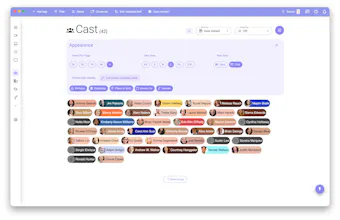
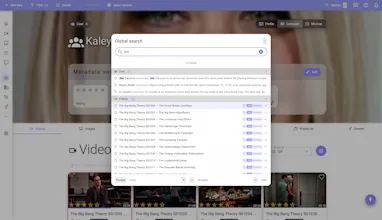
It's a desktop app for organizing, tagging, and browsing your local media library — videos, images, audio, and text. Add any metadata, which I call chips, to your files. Tags, actors, ratings, bookmarks with notes, dates, custom fields. Browse everything as visual cards, filter by any parameter, play in the built-in player with timeline markers.
Key features:
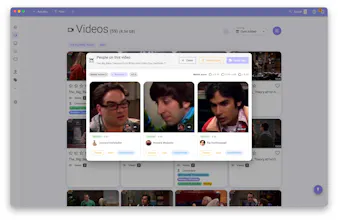
Face recognition in videos — automatic person tagging, all on-device
Advanced filtering with saved presets
Path-based tag extraction with optional ML model
Duplicate detection by fingerprint
Plugins for TMDB, Jellyfin, Plex, and Emby
Full customization: colors, card sizes, layouts, dark mode
Cross-platform: macOS, Windows, Linux, and Docker
Privacy-first. No accounts, no cloud, no data collection. Everything runs on your machine. Open-source under GPL v3.
And yes, there's a business model too. The free version gives you unlimited browsing and editing — you can tag and organize as many videos as you want. The only limitation is the video player, capped at 15 videos in the free tier. The full version is a one-time purchase for $20. It's fair, it's transparent, and it keeps the project sustainable.
My question to you is this. What is the one feature you wish existed in a media organizer that no tool currently does well?
I will be here in the comments all day. Ask me anything about the 6-year journey, the stack, the mistakes I made, or where this is going next. I am genuinely excited to hear your thoughts.
Check it out at https://mediachips.app
Source code at https://github.com/fupdec/MediaChips
P.S. If you want to see just how messy the early code was, the legacy Vue 2 branch is still there. I am keeping it as a reminder. And if you're curious about my LowDB mistake, just search the commit history. It's all there.