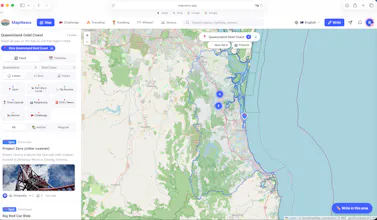
A map-based social app for your neighborhood. Instead of a follow feed, open the map to see what neighbors post nearby β local news, spots, events, and daily "Today's Neighborhood" photos. Record your town before it fades and share it worldwide, auto-translated in 11 languages.
No reviews yetBe the first to leave a review for Mapnews.app
Maker
π
Hey Product Hunt π
I'm a solo developer, and MapNews started from a simple wish: to discover,
record, and show off my own neighborhood.
Most social feeds are about who you follow. MapNews is about where you are β
you pin posts to a map, so opening your neighborhood shows what's happening
right around you: local news, hidden spots, events, and everyday street photos
("Today's Neighborhood").
The idea: if enough people snap one photo of their block, over months and
years it becomes a living, photographic history of that place β weather and all.
I built it all solo β maps, editor, ranking, moderation, 11-language i18n with
auto-translation, GDPR/PIPA compliance with one-tap data export. Would love
your honest feedback π
π mapnews.app
Report
Maker
Hey Product Hunt π
I'm a solo developer, and MapNews is what I've been building for the past year.
Most social feeds are endless and algorithmic. MapNews is the opposite β it's a map. Open it and you see what's actually happening in your neighborhood, pinned to the exact spot it happened. The person who lives there becomes the reporter.
A few things that make it different:
πΊοΈ Map-first, not a feed β you explore by place, not by algorithm
βοΈ Anyone's a citizen reporter β a new shop, a road closure, a lost cat, a street event
πΈ "Today" β snap a quick photo of your neighborhood. No title, no caption needed. The photo you take today becomes your town's history 10 years from now.
π Regional & reporter leaderboards, plus playful "Versus" and "Guess where" games
π Browse without signing in Β· 11 languages Β· runs right in your browser (no download)
I built the whole thing solo β the hardest part was normalizing administrative regions across countries so the map works worldwide. I'd genuinely love your feedback, especially on:
1. Map-first vs feed-first β which makes you stick around?
2. How would you approach the cold start of seeding hyperlocal content, city by city?
Thanks so much for taking a look π
Report
I looked around Mapnews, and while the features and technology don't seem much different from existing social media or maps, the idea itself is good. Displaying local news on a map, the openness of sharing one's neighborhood with other regions rather than keeping it a closed space, and the concept of becoming a local reporter to document one's communityβthese aspects seem very fresh.
Report
Maker
@jjcompanyΒ Honestly? There's no secret sauce in the tech. No breakthrough algorithm,
no feature you couldn't find somewhere else.
What's different is the idea itself β the lens.
Almost every social product organizes the world by time and by the people
you follow. MapNews organizes it by place. The map is the feed. A post
isn't a moment in a scroll; it's a pin that stays on the exact spot where
it happened.
That one shift changes what the product is for. Instead of an endless
stream you consume and forget, you're building a living, geographic record
of a neighborhood β one that anyone who lives there can add to, and that
grows more valuable over time. A photo you take today isn't just content;
in ten years it's local history, and you'll know exactly where it was.
So the moat isn't technical β it's the framing. "Local news, anchored to a
map, written by the people who live there" is a simple idea, but I haven't
seen it done as the core of a product rather than a feature bolted onto
something else.
I'd genuinely love to hear whether that framing resonates β or where you
Hey Product Hunt π
I'm a solo developer, and MapNews is what I've been building for the past year.
Most social feeds are endless and algorithmic. MapNews is the opposite β it's a map. Open it and you see what's actually happening in your neighborhood, pinned to the exact spot it happened. The person who lives there becomes the reporter.
A few things that make it different:
πΊοΈ Map-first, not a feed β you explore by place, not by algorithm
βοΈ Anyone's a citizen reporter β a new shop, a road closure, a lost cat, a street event
πΈ "Today" β snap a quick photo of your neighborhood. No title, no caption needed. The photo you take today becomes your town's history 10 years from now.
π Regional & reporter leaderboards, plus playful "Versus" and "Guess where" games
π Browse without signing in Β· 11 languages Β· runs right in your browser (no download)
Two short videos if you'd like a feel for it:
βΆοΈ 1-min overview: https://youtu.be/pF7XoRwKPCg
βΆοΈ The story behind "Today": https://youtu.be/L_UtMA6sIB4
Try it (no signup to look around): https://mapnews.app
I built the whole thing solo β the hardest part was normalizing administrative regions across countries so the map works worldwide. I'd genuinely love your feedback, especially on:
1. Map-first vs feed-first β which makes you stick around?
2. How would you approach the cold start of seeding hyperlocal content, city by city?
Thanks so much for taking a look π
I looked around Mapnews, and while the features and technology don't seem much different from existing social media or maps, the idea itself is good. Displaying local news on a map, the openness of sharing one's neighborhood with other regions rather than keeping it a closed space, and the concept of becoming a local reporter to document one's communityβthese aspects seem very fresh.
@jjcompanyΒ Honestly? There's no secret sauce in the tech. No breakthrough algorithm,
no feature you couldn't find somewhere else.
What's different is the idea itself β the lens.
Almost every social product organizes the world by time and by the people
you follow. MapNews organizes it by place. The map is the feed. A post
isn't a moment in a scroll; it's a pin that stays on the exact spot where
it happened.
That one shift changes what the product is for. Instead of an endless
stream you consume and forget, you're building a living, geographic record
of a neighborhood β one that anyone who lives there can add to, and that
grows more valuable over time. A photo you take today isn't just content;
in ten years it's local history, and you'll know exactly where it was.
So the moat isn't technical β it's the framing. "Local news, anchored to a
map, written by the people who live there" is a simple idea, but I haven't
seen it done as the core of a product rather than a feature bolted onto
something else.
I'd genuinely love to hear whether that framing resonates β or where you
think it breaks down.