
Macrokit Studio
A tiny local model does frontier-grade work — free, no key
5 followers
A tiny local model does frontier-grade work — free, no key
5 followers
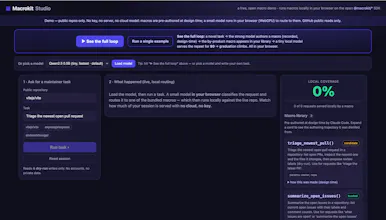
Macrokit Studio is a free, open demo: a small model in your browser does GitHub-maintainer work by running macros that a strong model encoded ahead of time. No signup, no API key, no server — nothing leaves your machine (open the network tab). It's an open format for macros plus free tools to build and run them. Apache 2.0, fully open.



Hey Product Hunt 👋
First, just try it — no signup, no API key, nothing to install: open https://studio.macrokit.dev and a tiny model does GitHub-maintainer work right in your browser. Open your network tab and you'll see nothing hits a server and nothing's billed.
The honest version of what Macrokit is and why it exists.
Most "agent" setups ask the model to reason through a multi-step workflow at runtime. A weak or local model loses the thread by step three — so people reach for a frontier API, and then the bill (or data-residency rules, or an air-gapped network) becomes the ceiling.
Macrokit flips the order. At design time, a strong model encodes a workflow once as a deterministic macro. At runtime, your weak/local model only classifies intent and dispatches that macro — no live multi-step reasoning. The hard part happens once, offline; the cheap part runs everywhere.
The piece I'm proudest of isn't the runtime, it's the CLI: macrokit gate reads your session logs and fails the build if an engineer reasoned at runtime instead of encoding a macro. It's a ratchet — your macro library compounds instead of rotting.
On the numbers: a 7B local model (Qwen 2.5, 4-bit, on a 16GB MacBook) scored 94.5% on a pre-registered 100-task intent-routing benchmark, with zero bail-outs. I published the failed first run (53.5%) right next to the fixed one — the methodology is fully open.
Apache-2.0, TypeScript, bring-your-own-model (OpenAI-compatible + Ollama out of the box). Repo + benchmark in the links.
Happy to get into any of it — the design-time/runtime split, the benchmark, or why this isn't "just LangChain with extra steps."