
Loomal
Monetize any MCP server in 5 minutes with no % skim.
561 followers
Monetize any MCP server in 5 minutes with no % skim.
561 followers
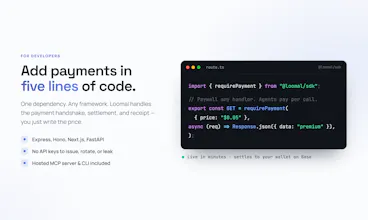
Loomal lets you charge for what you sell online — API calls, tools, digital products, or your whole store. One line of code (or a Shopify/WooCommerce plugin) adds an agent-ready paywall: AI agents pay you in USDC, settled in about 2 seconds, and you keep 100% of your revenue — no percentage cut, ever. Free to start, no card; flat monthly plans as you grow. Every paid listing appears on the Loomal Index, where agents discover and pay. Launch offer: first 500 sellers get 1,000 transactions free.
This is the 2nd launch from Loomal. View more
Loomal
Launching today
Loomal lets you charge for what you sell online — API calls, tools, digital products, or your whole store. One line of code (or a Shopify/WooCommerce plugin) adds an agent-ready paywall: AI agents pay you in USDC, settled in about 2 seconds, and you keep 100% of your revenue — no percentage cut, ever. Free to start, no card; flat monthly plans as you grow. Every paid listing appears on the Loomal Index, where agents discover and pay. Launch offer: first 500 sellers get 1,000 transactions free.




Free Options
Launch Team / Built With


Congrats on the launch! This is incredibly cool. I'm building my own personal agents as a hobby (openclaw calendar trackers, productivity managers etc.) and always thought the next step is agents having their own wallet and being able to transact with each other.
One particular hobby project I'm working on now is an android headunit agent that reads your car OBD data and keeps logs and alerts you when critical codes appear. It'd be so cool if the agent could schedule mechanic appointments and even pre pay for them according to the specific fault code that appears. Definitely will experiment with the SDK
Loomal
@kevin_win This is exactly the kind of thing we hoped would show up in the comments 😄 The OBD agent is a perfect example because it nails why agents need wallets: the moment your agent knows the fault code, it has more actionable context than you do — it knows the part, the urgency, and the fix. Making it stop there and wait for a human to phone a garage is throwing away the whole point.
The flip side is what makes it work end-to-end: the mechanic doesn't need an "AI strategy" — just a bookable, payable endpoint. Diagnostic lookup priced per call, appointment slot pre-paid against the fault code. That's a listing, not a re-platforming.
Please do experiment with the SDK — and when the car agent books its first appointment, come back and tell this thread. That's the demo nobody could argue with 🚗
The idea of agents buying APIs directly feels strange today, which usually means the idea is still early but definitely something that's gonna happen.
Loomal
@ragsyme Exactly. It feels unusual because most infrastructure is still designed around humans signing up, managing keys, and approving payments. As agents become more autonomous, discovering and paying for the tools they need will start to feel like the natural next step. We think that inflection point is coming sooner than most people expect.
Loomal
@ragsyme @dannyheng The funny thing is machines already buy from machines — we just don't call it that. Every API subscription is machine-to-machine service delivery where only the billing got routed through a human: someone signs up, pastes a card, provisions a key, and then software talks to software a million times. Agents paying directly doesn't create a new kind of transaction — it removes the one manual step left in an already-automated loop.
That's why we think "strange" fades fast here. Same arc as e-commerce in the 90s: typing your credit card into a website felt reckless right up until it felt normal. The trust infrastructure showed up, and behavior flipped within a few years.
We're just trying to be the boring plumbing that's already there when it flips.
Keeping 100% of revenue is a strong incentive. That alone makes me want to compare this with existing payment solutions. Well done!
Loomal
@ranjan_kumar45 Thank you! That was a deliberate choice—we want sellers to capture the full value of what they build rather than lose margin to another platform fee. We’d be very interested to hear how the comparison looks against the payment solutions you’re using today.
Loomal
@ranjan_kumar45 @dannyheng To save you some spreadsheet time on that comparison 😄 — the math gets stark at agent scale. Card rails charge ~2.9% + $0.30 per transaction. On a $0.05 API call, the fixed fee alone is 6x the payment — micropricing is structurally impossible there, which is why every API today forces you into monthly subscriptions and clunky key management instead of just… charging per call.
And % platform fees have a quieter problem: they scale with your success. Sell 10x more, pay 10x more, for the same infrastructure.
We flipped it — flat subscription for the infrastructure, per-call transactions settle 100% to you. Our revenue grows when more sellers find it worth paying for, not by skimming yours. Would genuinely love to see your comparison table when you make one — post it back here.
The thought of software quietly doing its own shopping while the creator still gets paid is a little wild and kind of exciting. Feels like a peek at how things are about to work, @dannyheng .
Loomal
@jean_noel_escande That "quietly" is the part that gets me too — the first time we watched an agent discover a tool, pay for it, and move on mid-task with no human anywhere in the loop, it stopped feeling theoretical. The plumbing for that moment is all we're really building. Thanks for the kind words — and if you've built anything agents should be able to buy, the door's open 🙂