
Loomal
Monetize any MCP server in 5 minutes with no % skim.
525 followers
Monetize any MCP server in 5 minutes with no % skim.
525 followers
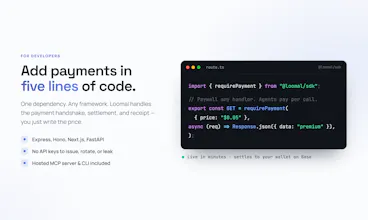
Loomal lets you charge for what you sell online — API calls, tools, digital products, or your whole store. One line of code (or a Shopify/WooCommerce plugin) adds an agent-ready paywall: AI agents pay you in USDC, settled in about 2 seconds, and you keep 100% of your revenue — no percentage cut, ever. Free to start, no card; flat monthly plans as you grow. Every paid listing appears on the Loomal Index, where agents discover and pay. Launch offer: first 500 sellers get 1,000 transactions free.
This is the 2nd launch from Loomal. View more
Loomal
Launching today
Loomal lets you charge for what you sell online — API calls, tools, digital products, or your whole store. One line of code (or a Shopify/WooCommerce plugin) adds an agent-ready paywall: AI agents pay you in USDC, settled in about 2 seconds, and you keep 100% of your revenue — no percentage cut, ever. Free to start, no card; flat monthly plans as you grow. Every paid listing appears on the Loomal Index, where agents discover and pay. Launch offer: first 500 sellers get 1,000 transactions free.




Free Options
Launch Team / Built With


Documentation.AI
The Shopify and WooCommerce plugins should help bring non-technical sellers into the agent economy much faster. :)
Loomal
@roopreddy Thats why we think the agent economy is going to explode! Native Shopify and WooCommerce integrations should let sellers expose what they already offer to agents without needing to understand APIs, MCP, or crypto infrastructure first.
Loomal
@roopreddy This is the part that changes the scale of the whole thing. Developers listing APIs is the beachhead, but the long tail of the agent economy is millions of existing stores where the seller will never read an API doc — and shouldn't have to. A plugin turns "agent-ready" from an engineering project into a checkbox in a dashboard they already use.
The day an agent can buy from a regular WooCommerce store as easily as from a purpose-built API, it stops being a developer economy and starts being the economy
honestly this looks pretty slick, the no percentage cut thing is huge. one thing though, would be great if there was a built in way to set usage tiers or rate limits per agent, so you could throttle heavy users automatically without having to monitor it yourself. would make scaling way less stressful.
Loomal
@golgelisem16238 Thanks — and fair point, this is a real gap. Today you set pricing per endpoint, but throttling per agent is on you. We already identify every paying agent per transaction, so per-agent limits and tiers are very buildable — adding it to the roadmap.
Quick question back: hard cutoffs (429 past a limit), or price-based throttling where heavy users just pay more per call? Curious which you'd actually want.
ConnectMachine
Congrats on shipping. One dashboard showing revenue, agent traffic, and transaction trends would make this even more valuable.
Loomal
@syed_shayanur_rahman Thanks! Agreed — analytics is where a lot of the value compounds.
Today the dashboard shows revenue and which resource each payment came from, so you can already see what's selling. Agent traffic patterns, transaction trends, repeat-buyer views — that's coming in upcoming releases. Analytics is one of the most-requested things from early sellers, so it's high on the list.
Anything specific you'd want to see beyond those three? Genuinely shapes what we build next.
curious how versioning works on the seller side. if I list a paid MCP tool and later change its input/output schema, do agents that already paid for the old contract get a grace period, or is there just one live version and everyone gets the new behavior immediately whether their integration expects it or not
Congrats on the launch! If one agent gets compromised, can you shut down just its identity, or does it affect the whole account?
Congrats on the launch! This is incredibly cool. I'm building my own personal agents as a hobby (openclaw calendar trackers, productivity managers etc.) and always thought the next step is agents having their own wallet and being able to transact with each other.
One particular hobby project I'm working on now is an android headunit agent that reads your car OBD data and keeps logs and alerts you when critical codes appear. It'd be so cool if the agent could schedule mechanic appointments and even pre pay for them according to the specific fault code that appears. Definitely will experiment with the SDK!
Loomal
@kevin_win This is exactly the kind of thing we daydreamed about while building. The OBD agent is a great example because it's the full loop: detect fault, find service, pay, all with zero human in the mood to deal with it 😄
The honest gap you'll hit: your agent can pay today, but the mechanic side needs an agent-payable endpoint too. That's the chicken and egg the Index exists to solve. Even a simple booking API with a deposit endpoint would make your demo work end to end.
Please do experiment with the SDK, and when the headunit agent makes its first payment, I want to see the video. You're in the founding 500 if you list anything. What's your stack on the agent side?
Congrats on the launch! This is incredibly cool. I'm building my own personal agents as a hobby (openclaw calendar trackers, productivity managers etc.) and always thought the next step is agents having their own wallet and being able to transact with each other.
One particular hobby project I'm working on now is an android headunit agent that reads your car OBD data and keeps logs and alerts you when critical codes appear. It'd be so cool if the agent could schedule mechanic appointments and even pre pay for them according to the specific fault code that appears. Definitely will experiment with the SDK
Loomal
@kevin_win This is exactly the kind of thing we hoped would show up in the comments 😄 The OBD agent is a perfect example because it nails why agents need wallets: the moment your agent knows the fault code, it has more actionable context than you do — it knows the part, the urgency, and the fix. Making it stop there and wait for a human to phone a garage is throwing away the whole point.
The flip side is what makes it work end-to-end: the mechanic doesn't need an "AI strategy" — just a bookable, payable endpoint. Diagnostic lookup priced per call, appointment slot pre-paid against the fault code. That's a listing, not a re-platforming.
Please do experiment with the SDK — and when the car agent books its first appointment, come back and tell this thread. That's the demo nobody could argue with 🚗