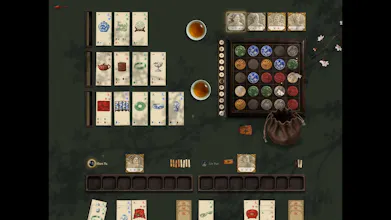
A quiet duel of extraordinary craft. Collect materials, build your workshop, and compete for commissions in a two-player strategy board game inspired by Splendor Duel, Terraforming Mars and centres of craft excellence in China. Play against the computer, share a device, or invite a friend online.
This game began on a trip to see where Chinese craft is still made: Jingdezhen, Yixing... I expected beautiful objects. What I did not expect was that every workshop ran on a different system, and that each system was already a game.
In Jingdezhen, a single porcelain piece passes through 72 hands. Nobody makes a vase; a vase is made by specialists who each do one thing and hand it on.
In Yixing, a teapot maker takes an apprentice, and years of their output belong to that lineage. Lacquer is layers and waiting, coat after coat, months for one box. Silver can be melted down and begun again, which no fired pot can do. Jade is subtraction: you cannot add material back, so every cut is final.
Those are not themes painted onto a board. They are different rules, and that is what Linglong is:
• Jingdezhen porcelain — two specialists with different techniques count as more than the sum of their work
• Yixing zisha clay — a master workshop teaches an apprentice, and the apprentice grows
• Cinnabar lacquer — inlay a pearl to raise the quality of a piece already under way
• Silver — withdraw your work from one commission and offer it to another
• Jade — the economical cut, paying one material less
The frame around them comes from games I love. The shared board of materials is Splendor Duel's idea and
I owe it that debt plainly. Craft-specific strategies, commissions both players compete for, and the pleasure of a table that slowly becomes a machine is Terraforming Mars. What I wanted that neither gave me was a reason to care what the pieces are.
This is a free playtest. The full version comes to Steam early next year, and everything you see here is playable now in the browser: no install, no account.
Play solo against three rival strengths, invite a friend with a link, or share one device. There's a five-minute lesson that teaches by playing a real game.
I'm still balancing the rules (an even deeper, more advanced ruleset can be enabled in Settings!) and every note from this week shapes what ships.
I would love to know: which craft did you enjoy most?
Report
Love the background music! :) Was a soundtrack or AI generated?




My Signature Dish
My Signature Dish
Hi everyone, maker here 🏺
This game began on a trip to see where Chinese craft is still made: Jingdezhen, Yixing... I expected beautiful objects. What I did not expect was that every workshop ran on a different system, and that each system was already a game.
In Jingdezhen, a single porcelain piece passes through 72 hands. Nobody makes a vase; a vase is made by specialists who each do one thing and hand it on.
In Yixing, a teapot maker takes an apprentice, and years of their output belong to that lineage. Lacquer is layers and waiting, coat after coat, months for one box. Silver can be melted down and begun again, which no fired pot can do. Jade is subtraction: you cannot add material back, so every cut is final.
Those are not themes painted onto a board. They are different rules, and that is what Linglong is:
• Jingdezhen porcelain — two specialists with different techniques count as more than the sum of their work
• Yixing zisha clay — a master workshop teaches an apprentice, and the apprentice grows
• Cinnabar lacquer — inlay a pearl to raise the quality of a piece already under way
• Silver — withdraw your work from one commission and offer it to another
• Jade — the economical cut, paying one material less
The frame around them comes from games I love. The shared board of materials is Splendor Duel's idea and
I owe it that debt plainly. Craft-specific strategies, commissions both players compete for, and the pleasure of a table that slowly becomes a machine is Terraforming Mars. What I wanted that neither gave me was a reason to care what the pieces are.
This is a free playtest. The full version comes to Steam early next year, and everything you see here is playable now in the browser: no install, no account.
Play solo against three rival strengths, invite a friend with a link, or share one device. There's a five-minute lesson that teaches by playing a real game.
I'm still balancing the rules (an even deeper, more advanced ruleset can be enabled in Settings!) and every note from this week shapes what ships.
I would love to know: which craft did you enjoy most?
Love the background music! :) Was a soundtrack or AI generated?