Launching today

Investment Journey Simulator
Simulate how real-life decisions reshape long-term wealth
4 followers
Simulate how real-life decisions reshape long-term wealth
4 followers
Investment Journey Simulator is an open-source Python + Streamlit tool for modelling how real-life decisions change long-term investment outcomes. Simulate SIPs, step-ups, pauses, lump sums, withdrawals, rebalancing, inflation, taxes, historical scenarios and Monte Carlo paths. Compare complete journeys and use Shapley-based attribution to explain which decisions created the difference. It does not predict markets or recommend investments.





Hi Product Hunt - I’m Sambit, the maker of Investment Journey Simulator.
This project started from a very personal frustration.
I had used SIP calculators, maturity calculators, portfolio tools and spreadsheets, but I kept running into the same limitation: they could tell me what might happen if everything went perfectly, but they struggled to represent what actually happens over a long financial life.
What if I lose a job and pause investing for a year?
What if I increase my SIP later?
Add a lump sum?
Start an SWP?
Withdraw midway?
Rebalance?
Add another investment?
Change several of these decisions at different points in time?
I first tried modelling these situations manually for my own planning. As the scenarios became more complicated, I started writing functions, then built a full simulation backend around them.
Over time it grew into something much larger: event-based investment journeys, multiple portfolios, withdrawals, rebalancing, taxation, inflation-adjusted purchasing power, historical scenarios, Monte Carlo simulation, reports & side-by-side journey comparisons.
One problem became particularly interesting: when several decisions change at once, their effects interact.
Measuring each decision independently can double-count those interactions. For supported comparisons, I therefore added Shapley-based attribution so the individual effects reconcile with the actual difference between two journeys.
In 2026, AI/LLM tools also helped me accelerate parts of the interface and productization, but the underlying modelling problem came from something I genuinely wanted for my own investing decisions.
The project is fully open source, built with Python + Streamlit and available for anyone to inspect, run & challenge.
A lot of effort has gone into making the calculations inspectable, the assumptions visible and the results useful for both someone asking a simple “what if?” and someone building a much more detailed investment journey.
The feedback I would value most is this:
What real-life investment event - or combination of events - have I still failed to model?
I’d also love feedback on the assumptions, edge cases, journey comparison & anything in the UX that feels unnecessarily complex.
Thanks for taking a look - happy to answer technical or modelling questions here.
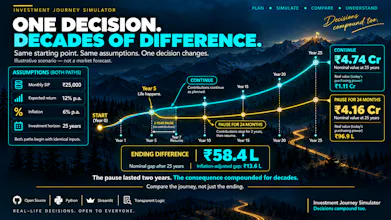
One simple scenario that explains why I built this:
Start with ₹25,000/month for 25 years.
Now pause investing for 24 months after Year 5 - then resume exactly as before.
Under the same illustrative assumptions, that temporary pause creates a surprisingly large difference decades later.
That’s the kind of question I wanted this simulator to answer: not just “what return will I get?”, but “what did this decision change?”
If you try it, I’d genuinely love to know the first real-life event you would add to the journey.