Launching today

Insider Desk
An iPhone app for insider trades, financials and futures
1 follower
An iPhone app for insider trades, financials and futures
1 follower
Insider Desk aggregates company, insider and market data from official public sources.




Hello.
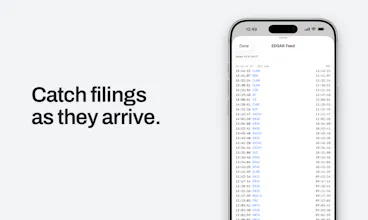
I'm building Insider Desk, a financial research tool for traders, investors, corporate professionals, finance professionals, and anyone else interested in the record of public companies. It gathers and processes SEC filings and CFTC data, models the information, and presents legible figures and charts: insider dollar flow company by company, with recent trading scored against the history of insider trading at the company; years of financial results; and positioning across ten futures complexes. It's native to the iPhone, and computes everything on-board, so your ideas and research stay private.
My objective is to deliver numbers that are placed in rich context, graded for fidelity, and charted to make the trajectory obvious, in a compact yet decently aesthetic presentation. Developing an investment thesis, or looking at your competitive set, requires a variety of metrics so that you can triangulate ideas, validating or invalidating an idea, confirming or modifying underlying assumptions, or being able to clearly see what "beats" or "misses" means for this particular circumstance. I wanted a place to go when I wanted an answer to the fundamental analysis, and I built Insider Desk for this.
One of the best uses I've found is AI coordination for developing a financial thesis. Screenshot the charts for your tickers, or the CFTC positioning on the futures board, and hand them to an AI assistant of your choice, which does what it's good at. Include the panels' explainers too: they say where the figures come from and the model behind them. Then the assistant knows that the flat range on the Growth-Profit rating comes from a Brown and Rozeff autoregression, or that the USD theme is the leveraged-fund net over gross for each currency pair, averaged across the seven, and has the context to interpret what it sees.
If you've worked with filings, you know where the difficulties are: fiscal calendars change and get mixed up, a fourth quarter that only exists inside the 10-K, restatements, spin-offs, discontinued operations, Form 4 amendments. An analyst handles those by judgment, and curates those maps by hand, per company. The key question for automated fundamental analysis is how to solve each of these problems individually over the generalized population of public companies, and then synthesize the results. The method is written up section by section in the Technology Overview: https://insiderdesk.info/technology/
Start with the company you know best. If you see a figure in the wrong place, I'd like to hear about it, and about what you would want to see next.