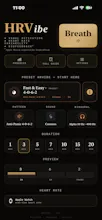
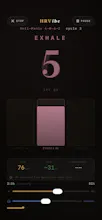
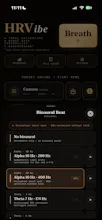
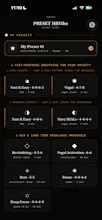
HRVibe is a live HRV biofeedback app for iPhone and Apple Watch. Breathe with guided patterns — resonance, box breathing, extended-exhale — while your Watch streams real heart data back as RMSSD, so you see your own vagal activation happen in real time. Binaural tones and custom soundscapes deepen the effect. Session history tracks HRV trends over time, with coaching insights and streaks. Built on HealthKit — your data stays yours. Made solo, in spare evenings, to help someone breathe easier.
Fin Startups get Fin free for a year + 93% off Intercom
Promoted
Maker
📌
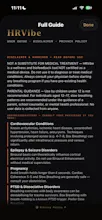
HRVibe is a breathing and heart-rate variability (HRV) biofeedback app for iPhone and Apple Watch. I built it to help someone very close and dear to me through a genuinely hard time, and it grew from there into a full tool built around one idea: help your body find its own calm, guided by its own signals.
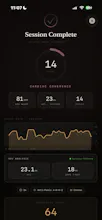
At its core is live HRV biofeedback. While you breathe, HRVibe reads beat-to-beat heart data from your Apple Watch. You're not just watching an animation — you're watching your live HRV (RMSSD), computed from a rolling window of your recent heartbeats, shift as your breathing settles. RMSSD is the metric most associated with vagal tone and parasympathetic activation.
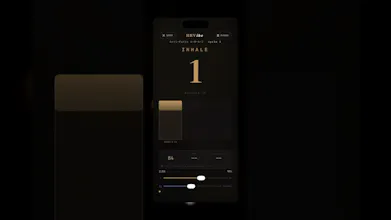
Breathing itself is built around multiple patterns, each targeting a different physiological goal: Cardiac Coherence (a slow 5-5 rhythm, six breaths a minute) for maximum HRV and vagal activation, Box Breathing for focus and pre-performance calm, and the classic 4-7-8 technique for winding down before sleep, among others. Every pattern is fully visual and audio-guided, with a smooth on-screen animation that expands and contracts with each phase, so you never have to count seconds yourself. You can also save your own custom presets once you find a rhythm that works for you.
Audio is a full layer of its own, not an afterthought. HRVibe includes binaural tone generation tuned to support relaxation and focus states, layered under ambient soundscapes, with independent volume control for the binaural layer so you can dial in exactly how present it feels. You can also import your own audio tracks and use them as the soundscape for a session, making the experience fully yours.
The Apple Watch app is a true companion, not a remote display. It runs its own autonomous breathing guide directly on the wrist — driven by an extended runtime session rather than a workout session, which is what Apple's guidelines require for this kind of app. That constraint pushed the whole data pipeline to be rebuilt around resilience: heart data reaches the iPhone practically in real time, not truly instantaneous, and if the connection drops, the Watch keeps guiding your breathing locally and reliably delivers the full session's data the moment it reconnects — even surviving an app relaunch or a restart.
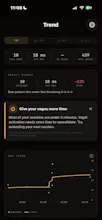
After each session, HRVibe runs a precise post-analysis using the Watch's full beat-to-beat heartbeat series, using the Karlsson (2012) artifact-correction method — comparing each interval against a local median to catch and clean outlier beats — before computing RMSSD. From there you get real trend tracking over time: session-by-session RMSSD, morning-versus-evening comparisons, and coaching-style insights that point out patterns you might not notice yourself. A light gamification layer — streaks and achievements — helps make consistency feel rewarding rather than like one more thing to keep up with.
All of this is built on Apple HealthKit, so your data stays where it belongs: in your own Health app, under your control, not on a third-party server. HRVibe was built by one person, in spare evenings — a tool that treats breathing not as a wellness trend, but as something measurable, trainable, and genuinely calming.