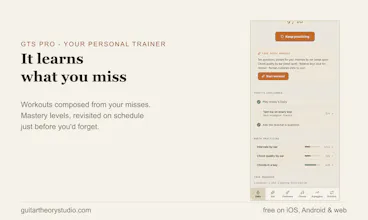
Ten daily theory questions, a fretboard that draws any scale, progressions with smooth voice leading, guided practice - every tool free, no account. GTS Pro trains you on what you miss. And Ask's AI can't hallucinate: it opens tools, never draws notes.
Hey Product Hunt! Solo builder here.
Guitar theory apps mostly come in two flavors: video courses that lecture at you, and listen-and-grade apps that judge your playing. I wanted a third thing — a tool you operate. Pick any key, see the scale on a real fretboard, build the progression, hear it, drill it.
Everything musical is free, no account needed: the Fretboard Explorer, the Chord & Progression Builder (25 classic progressions, Nashville numbers, voice-led shapes), sweep arpeggios for every chord in a key, and a metronome-driven Practice Loop — including guided timed practice that walks you through every position hands-free.
Two newer things this launch is really about:
The Daily — ten quick theory questions, the same seeded puzzle for everyone each day. Read the neck, name the chord, trust your ear. Miss one and it teaches you the answer, and your streak (plus a shareable score grid) builds the habit.
GTS Pro ($2.99/mo or $24.99/yr, 7-day trial) is a personal theory trainer built on those results: workouts composed from what you actually miss, mastery levels per skill revisited on schedule just before you'd forget, and full progress history with practice-time tracking.
The AI part works differently from most "AI guitar teacher" apps, and it's the part I'm most opinionated about: Ask never generates an answer. Type "show me D Dorian" or "a 12-bar blues in E" and the AI does exactly one thing — picks which tool to open and how to configure it. Every note, fret and spelling on screen comes from the same deterministic theory engine as the rest of the app. An AI that can't touch the notes can't hallucinate a fret. That constraint got battle-tested by a real user who asked for "3nps" patterns and caught Ask claiming we didn't have them (we do) — the fix shipped the same day.
Every answer and every setup is shareable as a link — the person you send it to lands on the same fretboard, set up the same way.
If you play, ask it for something weird and tell me what it does. And I'd genuinely love to hear what to build next — deeper ear training, a tuner, and backing tracks are all on the shortlist.