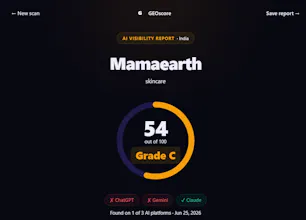
Every day, thousands of potential customers ask ChatGPT, Claude, and Gemini for recommendations in your category. Either your brand appears in that answer — or your competitor does. getGEOscoreai checks your brand visibility across all 3 major AI platforms simultaneously and gives you a score from 0-100. Free to check. No signup needed. 60 seconds. What you get: → GEO score 0-100 with letter grade → Which AI platforms mention you → Exactly what each AI says about your category
No reviews yetBe the first to leave a review for getGEOscore
Maker
📌
Hey Product Hunt! 👋
I'm Shashank — Marketing Head at an organic food brand in India and now founder of getGEOscoreai.
Six months ago I asked ChatGPT to recommend brands in our category.
Our brand wasn't there.
A competitor with half our reviews and a worse product was at position 2.
I had spent months on SEO. We ranked on Google.
ChatGPT had never heard of us.
That gap — between Google ranking and AI visibility — sent me into a 7-day building sprint.
Today getGEOscore is live. It checks your brand across ChatGPT, Claude, and Gemini simultaneously and gives you a GEO score from 0-100.
Here's what I found scanning 100+ brands:
→ Average score: 29/100
→ Only 8% of brands score above 70
→ Brands with Wikipedia pages score 40 points higher on average
→ Reddit mentions are the strongest predictor of AI visibility
The tool is completely free to check your score.
Would love your honest feedback — especially on:
1. Is the scoring methodology making sense?
2. What would make you pay for Pro?
3. What's your brand's GEO score?
Check yours free → getgeoscoreai.com
Thank you for being here on day 1.
This community means everything to an indie founder building from India. 🇮🇳
— Shashank
running an AI company, the part I'd want to stress test is stability. LLM outputs are non-deterministic even at fixed settings, and the underlying models get silently updated by the providers on their own schedule, not yours. if I check my score today and again in two weeks, how much of the delta is a real change in my brand's actual visibility versus just noise from sampling variance or a model version bump on OpenAI's end that had nothing to do with anything I did. is there a confidence interval or a "rescan for stability" built in, or is one 60-second check treated as the score?
Report
Maker
@galdayan This is a fantastic question, and honestly, one of the hardest problems in measuring AI visibility.
You're absolutely right—there are at least three independent sources of variance:
• Inference variance: the same model can produce slightly different outputs for the same prompt. • Model drift: providers like OpenAI, Anthropic and Google continuously update their models without exposing version-level control to developers. • Web evolution: your brand, competitors and the underlying web are constantly changing.
So if a score changes after two weeks, it's fair to ask: Was it my work, or did the ecosystem move?
We don't believe a single scan should ever be treated as absolute truth. We think of GEOscore much more like a health check than a lab measurement. One scan gives you a useful snapshot, but the real value comes from observing trends over time and understanding why the score moved.
That's also why the recommendations matter as much as the number itself. If your score changes by a few points but the underlying strengths and gaps remain the same, that's very different from a scan that identifies new opportunities or a meaningful shift in how AI understands your brand.
Longer term, we're exploring ways to make this even more robust through repeated sampling, stability indicators, longitudinal tracking and confidence measures, so users can better separate genuine movement from normal model variance.
The reality is that AI search is still an evolving ecosystem. We don't think the industry needs another tool claiming perfect precision. It needs measurement that is transparent about uncertainty while still being useful for making better decisions.
Really appreciate you raising this—it's exactly the kind of discussion we want to have while the category is still taking shape.
@shashankgetgeoscore that "health check not lab measurement" framing actually makes me trust it more, not less. practical question though - once the longitudinal tracking exists, how many data points before you'd tell a user "trust this trend"? like if someone scans weekly for a month, is 4 points enough to call something real, or is the stability work you mentioned going to need more history than that before it separates signal from noise for a fast mover
Report
Maker
@galdayan That's exactly the question we've been debating internally.
My current thinking is that "number of scans" isn't actually the right variable. Context is.
Let's say you scan your brand every week for four weeks and nothing meaningful changes. No new content, no PR, no product launch, no major competitor activity, and no obvious provider-side shifts. In that scenario, four observations may already be enough to establish a fairly stable baseline.
But imagine another company that just published 30 articles, earned press coverage, launched three landing pages, and OpenAI rolled out a retrieval update in the same period. The exact same four scans carry a very different level of confidence because there are multiple moving variables.
Personally, I think the future isn't a dashboard that says:
"Your score is 67."
It's a system that says:
"Your score moved, but this looks like normal model variance."
"Your score moved because your entity understanding improved."
"Your score moved, but we're seeing a similar shift across hundreds of brands, so this is likely an ecosystem-level change rather than something unique to you."
That's the distinction I care about.
One thing we've learned while building GEOscore is that AI visibility isn't like measuring page speed or Core Web Vitals, where the environment is relatively deterministic. Here we're measuring something that sits on top of multiple constantly evolving systems, LLMs, retrieval pipelines, search indexes, the public web, and your competitors, all changing independently.
Because of that, I don't think the industry should be chasing false precision. A confidence interval isn't enough on its own if you don't understand what contributed to the movement.
Where I think this category ultimately needs to go is closer to observability than analytics. Not just "did the score change?" but "what's the most likely explanation for the change?"
That's a much harder problem, but I also think it's the problem worth solving.
So the honest answer today is: we're still learning where that confidence threshold should be. I don't think anyone has enough longitudinal data yet to claim a universal rule. But as more brands use GEOscore, we'll have the opportunity to separate persistent trends from normal AI noise with a lot more confidence.
Really appreciate you pushing on this. These are exactly the kinds of questions that will shape the next generation of AI visibility measurement.
@shashankgetgeoscore the observability framing makes sense, but the attribution part seems like the actual hard problem: separating "my content changed" from "the model changed" from "everyone's scores moved" basically requires seeing other brands' data, not just mine. is that cross-brand signal something you can only get once you have enough customers to see the ecosystem-level shift, or is there a way to bootstrap that comparison earlier
Report
How does the scoring actually work under the hood, like is it based on a fixed set of prompts or do you rotate the queries to keep it fair across niches?
Report
Maker
@metehanhd3h Great question! We intentionally don't rely on a single fixed prompt because that would make the score too dependent on one wording or one use case.
Instead, GEOscore evaluates brands across a diverse set of business-relevant queries and combines multiple signals to build a more balanced picture of AI visibility. The goal is to measure how confidently AI understands and recommends a brand across different contexts, rather than how well it performs on one prompt.
We're continuously refining the methodology as AI search evolves, so the score reflects real-world discoverability as closely as possible.
Report
I ran it on my own site and the result felt genuinely well grounded - the gaps it flagged matched what I already suspected, and it was more accurate than another tool I'd tried before. Nicely done :)
Report
Maker
@alieksia Thank you, that genuinely means a lot. We spent a lot of time trying to make the recommendations practical rather than just generating a generic AI report. Hearing that it matched what you already suspected is probably one of the best validations we could ask for. Really appreciate you taking the time to try it!
Report
@shashankgetgeoscore what would you recommend as the first step for someone with a low GEO score .
Report
Maker
@dipanshu_kushwaha5 Great question! I'd start with understanding why the score is low before trying to improve it.
In most cases, it's not one big issue, it's a combination of unclear positioning, limited third-party mentions, weak topical authority, or technical barriers that make it harder for AI to understand your site.
Fix the biggest gap first, then rescan. Small improvements tend to compound over time. 🙂




Dial
running an AI company, the part I'd want to stress test is stability. LLM outputs are non-deterministic even at fixed settings, and the underlying models get silently updated by the providers on their own schedule, not yours. if I check my score today and again in two weeks, how much of the delta is a real change in my brand's actual visibility versus just noise from sampling variance or a model version bump on OpenAI's end that had nothing to do with anything I did. is there a confidence interval or a "rescan for stability" built in, or is one 60-second check treated as the score?
@galdayan This is a fantastic question, and honestly, one of the hardest problems in measuring AI visibility.
You're absolutely right—there are at least three independent sources of variance:
• Inference variance: the same model can produce slightly different outputs for the same prompt.
• Model drift: providers like OpenAI, Anthropic and Google continuously update their models without exposing version-level control to developers.
• Web evolution: your brand, competitors and the underlying web are constantly changing.
So if a score changes after two weeks, it's fair to ask: Was it my work, or did the ecosystem move?
We don't believe a single scan should ever be treated as absolute truth. We think of GEOscore much more like a health check than a lab measurement. One scan gives you a useful snapshot, but the real value comes from observing trends over time and understanding why the score moved.
That's also why the recommendations matter as much as the number itself. If your score changes by a few points but the underlying strengths and gaps remain the same, that's very different from a scan that identifies new opportunities or a meaningful shift in how AI understands your brand.
Longer term, we're exploring ways to make this even more robust through repeated sampling, stability indicators, longitudinal tracking and confidence measures, so users can better separate genuine movement from normal model variance.
The reality is that AI search is still an evolving ecosystem. We don't think the industry needs another tool claiming perfect precision. It needs measurement that is transparent about uncertainty while still being useful for making better decisions.
Really appreciate you raising this—it's exactly the kind of discussion we want to have while the category is still taking shape.
Dial
@shashankgetgeoscore that "health check not lab measurement" framing actually makes me trust it more, not less. practical question though - once the longitudinal tracking exists, how many data points before you'd tell a user "trust this trend"? like if someone scans weekly for a month, is 4 points enough to call something real, or is the stability work you mentioned going to need more history than that before it separates signal from noise for a fast mover
@galdayan That's exactly the question we've been debating internally.
My current thinking is that "number of scans" isn't actually the right variable. Context is.
Let's say you scan your brand every week for four weeks and nothing meaningful changes. No new content, no PR, no product launch, no major competitor activity, and no obvious provider-side shifts. In that scenario, four observations may already be enough to establish a fairly stable baseline.
But imagine another company that just published 30 articles, earned press coverage, launched three landing pages, and OpenAI rolled out a retrieval update in the same period. The exact same four scans carry a very different level of confidence because there are multiple moving variables.
Personally, I think the future isn't a dashboard that says:
"Your score is 67."
It's a system that says:
"Your score moved, but this looks like normal model variance."
"Your score moved because your entity understanding improved."
"Your score moved, but we're seeing a similar shift across hundreds of brands, so this is likely an ecosystem-level change rather than something unique to you."
That's the distinction I care about.
One thing we've learned while building GEOscore is that AI visibility isn't like measuring page speed or Core Web Vitals, where the environment is relatively deterministic. Here we're measuring something that sits on top of multiple constantly evolving systems, LLMs, retrieval pipelines, search indexes, the public web, and your competitors, all changing independently.
Because of that, I don't think the industry should be chasing false precision. A confidence interval isn't enough on its own if you don't understand what contributed to the movement.
Where I think this category ultimately needs to go is closer to observability than analytics. Not just "did the score change?" but "what's the most likely explanation for the change?"
That's a much harder problem, but I also think it's the problem worth solving.
So the honest answer today is: we're still learning where that confidence threshold should be. I don't think anyone has enough longitudinal data yet to claim a universal rule. But as more brands use GEOscore, we'll have the opportunity to separate persistent trends from normal AI noise with a lot more confidence.
Really appreciate you pushing on this. These are exactly the kinds of questions that will shape the next generation of AI visibility measurement.
Dial
@shashankgetgeoscore the observability framing makes sense, but the attribution part seems like the actual hard problem: separating "my content changed" from "the model changed" from "everyone's scores moved" basically requires seeing other brands' data, not just mine. is that cross-brand signal something you can only get once you have enough customers to see the ecosystem-level shift, or is there a way to bootstrap that comparison earlier
How does the scoring actually work under the hood, like is it based on a fixed set of prompts or do you rotate the queries to keep it fair across niches?
@metehanhd3h Great question! We intentionally don't rely on a single fixed prompt because that would make the score too dependent on one wording or one use case.
Instead, GEOscore evaluates brands across a diverse set of business-relevant queries and combines multiple signals to build a more balanced picture of AI visibility. The goal is to measure how confidently AI understands and recommends a brand across different contexts, rather than how well it performs on one prompt.
We're continuously refining the methodology as AI search evolves, so the score reflects real-world discoverability as closely as possible.
I ran it on my own site and the result felt genuinely well grounded - the gaps it flagged matched what I already suspected, and it was more accurate than another tool I'd tried before. Nicely done :)
@alieksia Thank you, that genuinely means a lot. We spent a lot of time trying to make the recommendations practical rather than just generating a generic AI report. Hearing that it matched what you already suspected is probably one of the best validations we could ask for. Really appreciate you taking the time to try it!
@shashankgetgeoscore what would you recommend as the first step for someone with a low GEO score .
@dipanshu_kushwaha5 Great question! I'd start with understanding why the score is low before trying to improve it.
In most cases, it's not one big issue, it's a combination of unclear positioning, limited third-party mentions, weak topical authority, or technical barriers that make it harder for AI to understand your site.
Fix the biggest gap first, then rescan. Small improvements tend to compound over time. 🙂