
Gateplex
Real-time governance firewall for autonomous AI agents
8 followers
Real-time governance firewall for autonomous AI agents
8 followers
Gateplex intercepts every AI agent action in real time before it executes. Set guardrail rules, block financial transactions over threshold, detect PII, and export compliance-ready audit trails. One API call. Any LLM. Any framework.




Hey Product Hunt 👋
I'm Umair, and I've spent years in fintech watching companies move fast with AI and get burned later.
Today I'm launching Gateplex, a real-time governance firewall for autonomous AI agents.
Here's the problem nobody talks about:
AI agents are already running in production. They're processing payments. Accessing health records. Sending emails on behalf of users. Making decisions that can't be undone.
Tools like Langsmith log what happened. That's useful, after the damage is done.
Gateplex stops the action before it executes.
One API call wraps your agent. Every action hits the firewall first. Your rules decide what goes through and what gets blocked. Everything is logged in a tamper-evident audit trail.
What you get with Gateplex:
• Live intercept feed showing every agent action in real time
• Configurable guardrail rules (block transactions over $X, detect and mask PII, flag sensitive operations)
• Per-agent monitoring and analytics
• Tamper-evident audit log
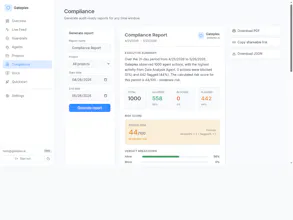
• One-click compliance PDF export
• Python SDK with OpenAI and Anthropic patchers — zero code changes to your existing agents
• MCP server listed on Smithery, Glama, and MCP.so
Who built this for:
Developers shipping agents with LangChain, CrewAI, AutoGen, or the OpenAI/Anthropic SDKs. CTOs who need to answer "what did the agent do and why" to a regulator, auditor, or board. Compliance and legal teams at fintech, healthcare, and legal companies who can't rely on vibes.
This is especially urgent in regulated industries. "We'll review the logs after" is not a compliance posture. It's a liability.
Try it free at gateplex.ai. Pro is $199/month.
Happy to answer any questions below. If you're building agents in production and thinking about governance, I'd love to hear what you're dealing with.
@umairsheikh The "log what happened is useful after the damage" framing is exactly right, post-hoc audit is a liability dressed as a feature in regulated work. The hard question for anything inline though: every action hitting the firewall first means every action eats a round-trip before it executes. For a chatty agent doing dozens of tool calls, that latency compounds fast, and the moment governance makes the agent feel slow, teams start carving out exceptions, which defeats the point. How are you keeping the intercept cheap, local policy eval vs a remote call per action? That tradeoff between "inspect everything" and "stay invisible" is the whole game for a firewall in the hot path.
@artem_fedorovich This is exactly the right question and the tension you are describing is real.
Current architecture makes a remote call per intercept. Latency sits under 100ms in practice for most agent workflows which is acceptable when agents are doing meaningful work between calls. But you are right that a chatty agent doing rapid fire tool calls would feel it.
The roadmap answer is local policy evaluation. A lightweight policy engine that runs in process and only phones home for logging and complex rule evaluation. Fast path for simple rules like spend limits and PII patterns evaluated locally, slow path for anything requiring context or ML based classification.
The carve out exceptions failure mode you mention is the real governance risk. Our bet is that keeping the default path fast enough that nobody feels the need to bypass it matters more than theoretical throughput. An incomplete firewall is worse than a slightly slower one.
Would genuinely welcome your perspective on where you have seen this tradeoff handled well. The teams building in this space are small enough that the conversation is worth having openly.