
fileAI
Build decision-ready AI workflows with trusted data
4.9•18 reviews•800 followers
Build decision-ready AI workflows with trusted data
4.9•18 reviews•800 followers
fileAI gives developers structured, zero-shot data from any file, with built-in fraud checks to surface signals of tampering and AI-generated content. Built for LLMs and AI agents, our AI data extraction is optimised for performance, transforming unstructured files into clean, enriched, and validated data, ready for downstream automation via configurable UI, developer portal, API or MCP.
Check us out: developer.file.ai
This is the 3rd launch from fileAI. View more

fileForensics
Launched this week
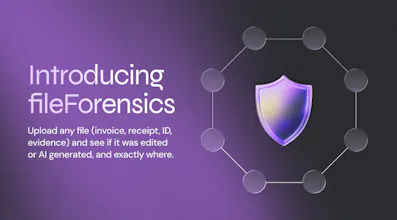
fileForensics is a trust check for every file your app or agent acts on. Extraction tells you what a document says; fileForensics tells you whether to believe it.
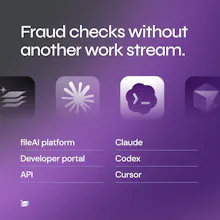
It looks for signs of editing, AI-generated content, tampering and details that don’t add up, then returns findings with the evidence: what, where and why. No black-box score. All delivered in one call and works via API, MCP (Claude, Cursor, Codex), the developer portal and the fileAI platform.
Check the file before you trust the data.




Free Options
Launch Team / Built With


Render Sandboxes: a computer for every agentIsolated compute, persistent state and a real filesystem
Promoted


Showing where a file looks unusual is more useful than a bare warning. I'd want the reviewer to be able to inspect that evidence and distinguish an ordinary edit from something that needs investigation.
@oleksii_sekundant Totally agree, Oleksii! A bare “suspicious” flag isn’t much help on its own. Reviewers need to see why. That’s why fileForensics looks across several signals: file structure, edit and signature history, visual tampering and details that contradict each other. That way an ordinary edit can be told apart from something worth investigating. Thanks for the thoughtful take. This is exactly the kind of feedback we love!
congrats on the launch! I'm in RevOps so clean data is basically my whole job, and catching edited or AI-made files before they become bad data downstream is a big deal. curious what docs people usually test this on first?
@harris_prasetyo Thanks so much, Harris! You nailed it. Bad documents become bad data downstream, so catching them at the start saves a lot of cleanup later.
@harris_prasetyo Teams usually start with the documents that trigger decisions or payments: invoices, bank statements, IDs and contracts. Which ones flow through your RevOps stack the most?
@shubhanshi_jangid1 I'm more on the CRM side, so for me it's mostly signup data in HubSpot, not documents. but same idea really, the cleaner the data coming in, the less I have to fix later. invoices and bank statements makes sense as a starting point
Showing where and why a file was flagged feels more useful than a single score. It also makes it easier to send uncertain cases for review.
I work in marketing at fileAI, and the most surprising thing people have told me today is how quickly the conversation has shifted from “Can AI read this document?” to “Can I actually trust the document in the first place?”
We’ve had some really interesting conversations around edited invoices, AI-generated documents, false positives, and what happens when the usual metadata evidence is no longer available.
fileAI fileforensics looks like a massive win for lab sciences. The ability to instantly surface hidden anomalies, verify file origins, and automate data integrity checks could save teams dozens of hours during audit prep. It essentially acts as an automated quality assurance layer for scientific data.
Questions for the team:
Can it handle proprietary binary file formats from common lab instruments (like chromatography or mass spec software), or does it require conversion to standard formats like PDF/CSV first?
How does it handle integration with existing LIMS (Laboratory Information Management Systems) or ELNs?
Excited to see where you take this. Definite upvote!