
easyspecs.ai
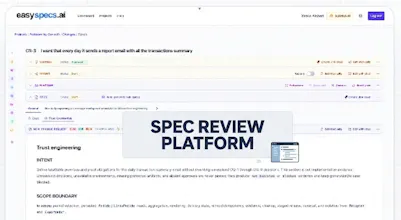
The spec review platform
167 followers
The spec review platform
167 followers
The gap between 1.5x and 100x isn't speed, it's trust!! AI agents generate code 100x faster than humans write it. But your team can't review it all. EasySpecs documents undocumented codebases and turns them into trustworthy specifications, so spec review becomes your new merge request review. Ground your agents in reality. Scale agentic development without babysitting. Document the foundation once. Review specs including Oracles and Rubrics and Ship code you actually verified.





Free Options
Launch Team

Render: Get up to $100K in startup creditsThe fastest way to launch and scale your startup in the cloud
Promoted
Hey Product Hunt 👋
I'm Xesca, CTO turned founder. Before EasySpecs, I spent 15+ years being the person accountable for code I didn't personally write, across fintech, insurtech, and media.
That's the job now for every engineering leader: your agents ship code faster than anyone can read it, and you're still the one who answers for what breaks.
The problem
I kept hitting the same wall everywhere I looked:
Teams adopt AI coding agents, and PRs pile up faster than anyone can review them
Specs get written against a mental model of the codebase, not the actual codebase
Agents generate code against those specs
Things break silently, and nobody can trace why, because nobody documented what was actually there to begin with
Code review is dead. Spec review is where quality lives now. But spec review only works if the spec is grounded in reality, not guesswork.
What EasySpecs does
Two things, one workflow:
1. We document your codebase automatically
Even the undocumented, nobody-wants-to-touch-it kind. Our first real test was a pharmaceutical company's legacy Delphi system. If it works there, it works on whatever you're building.
2. We turn that understanding into specs your team and your agents can actually trust
Every spec comes paired with validators, so you know it matches the app before anyone codes against it.
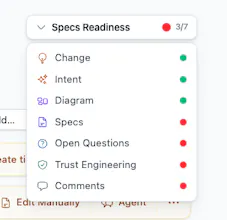
Here's the part I'm most proud of: as you write a spec, the specs crafter suggests oracles and rubrics for it, concrete, checkable ways to verify the change actually did what the spec said.
Oracles — the "does this pass or fail" checks a machine can run
Rubrics — the judgment calls that need a human or an AI reviewer to score against clear criteria
You're not staring at a blank page trying to guess how to verify your own spec. The tool proposes it alongside the spec itself.
Built for more than developers
You don't need to be a developer to use it. Right now the only way to sanity-check a spec against reality is to go read the source yourself.
We built EasySpecs so product managers and team leads get that confidence without opening a single file.
Try it
Free to start — connect a repo, bring your own AI key, see what it finds
Workbench — €5/repo/month while launch pricing lasts (normally €10)
Factory — €150/month if you want us to run the AI side too, with credits to use on any repo
I'd genuinely love your feedback, especially if you throw a messy, undocumented codebase at it. That's the case we built for.
@xesca_i_am nice launch congrats for shipping 🙌
@xesca_i_am How accurate is the documentation when the codebase is really large and messy ?
@dipanshu_kushwaha5 its actually hard to mesure but our clients were saying that better than most open source solutions out there. Specially due to our super strict validation in the generation, we have so many validators that I actually lost count on how many we have. to the point we had a lot of problems to actually make the solution converge, because we were detecting "errors" and then the validator was not passing but then the AI agent did not know how to solve it ... which forced us to have a 6 different models not 2 not 3, 6!! yes to read well.
@meet_patel24 Yes we have a MCP server that allows coding agents to download the generated specs. Also they can mark the spec as implemented.
How does EasySpecs handle specs for complex legacy systems?
@imfenil16 yes it does, we even tested with some clients with legacy code with languages like Delphi and other reaaaaally old frameworks that are hardly maintained for their teams.
Can EasySpecs automatically detect gaps between specs and the existing codebase??
@imrishit98 we generate the "context" from zero directly from the code. So all is always included. We are going to launch soon a Drift Specs vs Code feature but is not yet in production which I guess is more what you are really asking.
How do you keep the specs tied to the code over time, do they update automatically when the code changes?
@naimz we dont in the way you are thinking. that's why the tools has two main functions, 1.- Help you craft the best (change request (feature, fix, bug, whatever) and 2.- the automatic documentation based on the code. We all have been complaining since always that we dont have an updated documentation of the application the tool does this automatically for you.
This is a really useful product for AI teams How do you see EasySpecs fitting into the dev workflow long term?
@shivam_kushwaha16 humans need a UI to interact with the "what we want build" -> lets call it the change request, lets call it the ask, whatever is, needs to be validated, reviewed and understood.
@xesca_i_am got it
Didn't know that these sort of tools existed. Excited to see this in action going forward
@therahulpahuja sure, still a new things, only the real top people are doing spec reviews, but wait that's going to explode!