
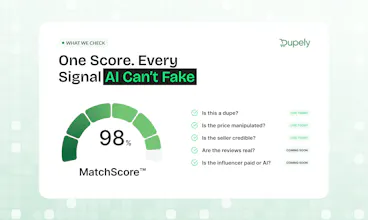
Most shopping tools chase coupons. Dupely tackles trust. Online shopping is full of manipulation: artificial price drops, fake reviews, paid influencers, and sketchy white label sellers reselling the same product at a markup. DupeScore finds identical products for less. Trust This Price flags fake savings using 90 days of price history. Seller badges show you who's actually credible. Now on iOS, Android, and Chrome. Dupely is the trust layer online shopping has been missing.




How does Dupely decide which sellers get the credibility badges, and is there any way for a legit seller to dispute one if it looks off?
@zehracimenb9f8 Great question Zehra, we use a couple of factors like seller rating and product return volume. These are signals Amazon puts out for each seller. Thanks for using Dupely! :D
How does the DupeScore actually verify that two listings are truly identical, since so many white label sellers tweak the title or one tiny spec to dodge comparison tools?
@yeimsurett79dy Great q Yesim! We use a variety of signals on the product listing like the images and description. We're able to tell if the differences are just tiny tweaks or totally distinct. The score we render is a synthesis of those signals. Thanks for using Dupely! :D
Congrats on the launch! 👏🏻 @jacob_galajda Tackling the white-label markup problem is a massive pain point. Curious about the DupeScore—how does it actually differentiate between an algorithmic price drop and a fake discount, especially during major sales events?
@nischal_kharel Thank you Nischal! Great q, we use historical data to determine what the overall price should be. The "price drops" we've observed on the data side typically do not go past this value, but they trigger Amazon to award badges and promote the product. Even during prime day, we observed a bunch of products that did this and were still able to surface dupes that had a better price. Thanks for using Dupely! :D
How does Dupely actually verify its seller badges, especially for those random white label shops that pop up overnight and disappear just as fast?
@hsangzkencbss Great q Ihsan! We use the seller data provided by Amazon to verify sellers and return data on products for the actual product listing we recommend. This way, you'll get good deals and know they come from good vendors! Thanks for using Dupely! :D
How does Dupely figure out which white label sellers are actually the same product under different brand names, and does it work for marketplaces like AliExpress or mostly just Amazon and the usual big stores?
@onurwhww Great q Onur, we use multiple signals from the product listing pages to derive a similarity score. Little changes will result in higher DupeScore but completely different products will not score very highly. Thanks for using Dupely! :D
How does DupeScore actually decide when two products are "identical" enough to recommend, especially for things where listings vary a lot in bundle size or packaging?
@saniyelaloypur Great q Saniye! There are a ton of Amazon listings that vary a lot in bundle size/packaging. We use multiple signals to derive a weighted score. The trust signals for products also help maintain the level of credibility whenever we recommend alternatives. Thanks for using Dupely! :D
How does DupeScore actually decide two products are real duplicates versus just similar items, especially when brands deliberately rename or repackage the same thing?
@ezelrikliahcg Great q Ezel! We use multiple signals from the product listing pages for relative similarity. We'll also bake in seller reputability too so even if it's a cheaper deal, you'll know you're still getting a good product too. Thanks for using Dupely! :D