
Dual N Back
Science-backed brain trainer for memory and focus.
7 followers
Science-backed brain trainer for memory and focus.
7 followers
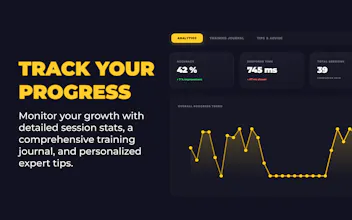
I built Dual N Back because I wanted a simple way to train my working memory and see whether I was actually improving. Most trainers I tried felt outdated, repetitive, or showed too little progress data. So I created a free web-based trainer with adaptive difficulty, detailed analytics, customizable sessions, daily goals, and reminders. No installation required. The product is still evolving, and I’d love your feedback.


Free
Launch Team / Built With


ClarifyThe Full-Stack AI CRM that replaces 5 tools.
Promoted
Nice to see a free option for this. How does the adaptive difficulty actually decide when to bump the level up or down during a session?
@ylmazturan3du8
Hi! Thanks for your question!
The adaptive difficulty is based on your overall accuracy at the end of each round, using performance across both position and audio matches.
If accuracy is above 80%, you move up one N-level.
Between 51% and 80%, you stay at the current level.
Below 20%, you immediately drop one level.
And if accuracy stays between 20% and 50% for 3 consecutive rounds, the level drops by one as well.
I added the 3-round buffer to avoid changing the difficulty too aggressively after one weaker round.
I'm still refining the adaptive system, so I'd be curious to hear what you think after trying a few sessions!
How does the adaptive difficulty decide when to bump up or down, and does it lean on any published n-back research for the pacing?
@mer1060139
Thank you for your question!
The difficulty adjusts after each 22-trial round based on overall accuracy.
Above 80%, you move up one N-level.
Between 51% and 80%, you stay at the same level. Below 20%, you move down immediately.
If accuracy stays between 20% and 50% for three rounds in a row, you move down one level.
The adaptive approach was inspired by published Dual N-Back research, including Jaeggi et al.
(2008).
I adapted the methodology for self-paced training by adding a 3-round buffer, so one weaker round doesn't immediately lower the difficulty.
I'm continuing to refine the system based on user feedback and training data.
How does the adaptive difficulty actually work under the hood, like does it adjust based on real-time accuracy or some other metric you track?
@berkkalpcqbtd
Thanks for the question!
The difficulty doesn't change in real time during a round.
The N-level stays fixed for all 20–22 stimuli so the user can maintain focus and a consistent rhythm.
The adjustment happens only after the round is completed, based on the overall accuracy for that round.
I also track average reaction time and separate accuracy scores for position and audio matches.
These metrics are saved in the user's history and used for analytics and progress tracking, but they don't currently affect the difficulty adjustment algorithm.
As the product evolves, I plan to explore more advanced personalization and adaptation methods if user feedback and training data show that they would improve the experience.
Tried it for a few rounds and the adaptive difficulty feels really well tuned. Also appreciate that it runs right in the browser without any setup.
@bulembackdnup
Thanks for trying it out!
Really glad to hear the adaptive difficulty felt well tuned after a few rounds.
Making the training easy to start directly in the browser without any setup was important to me from the beginning.
Thanks for the feedback — I really appreciate it!