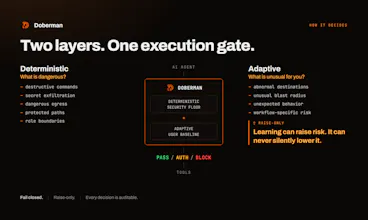
Doberman is an open-source, runtime security layer for AI coding agents. It sits between the agent and its tools and gives every action a PASS, AUTH or BLOCK verdict before it runs. A deterministic core catches known dangerous behavior, while an adaptive layer learns what’s normal for you and raises risk when something looks off. It fails closed and learning is raise-only. Works with Claude Code, Codex, OpenClaw and MCP clients like Cursor.
Hey ProductHunt, I'm Alan!
Doberman started because Claude deleted my project about 10 minutes before a hackathon demo. Safe to say I did not win that hackathon.
After that I kept thinking about how much access we're giving AI coding agents: My shell, credentials, source code, APIs, sometimes even production code. You can try to stop every bad prompt, hallucination or injection upstream, but when an agent is about to do something dangerous I want the final safety net before the call reaches the tool.
So I built Doberman.
It sits on the execution path between an agent and its tools. Every action gets one verdict before it runs:
PASS → let it through
AUTH → stop and ask me
BLOCK → never send it downstream
Underneath that is a two-layer security model.
First is the deterministic core. This is the non-negotiable safety floor. Things like destructive commands, secret exfiltration, path violations, dangerous egress and role boundaries are evaluated against explicit rules. It doesn't care whether the model says an action is safe and it doesn't get "convinced" out of these rules
What makese Doberman different is the subjective layer that adapts to your use case.
Because what should make Doberman suspicious depends a lot on how you actually work.
Sending data to a certain API might be completely normal for your workflow and weird for mine. An agent suddenly touching far more files than usual, using an unfamiliar destination or behaving differently from its baseline might not be malicious, but it's probably worth stopping and asking.
So Doberman learns what's normal for you and uses that as another signal. If something looks unusual, it can raise the action from PASS to AUTH or BLOCK.
The important part is that learning is raise-only. It can automatically make Doberman more cautious, but it can never loosen the deterministic safety floor without your explicit say so. And if Doberman errors or can't make a safe decision, it fails closed.
These two work in tandem, the deterministic policies stop the obviously dangerous actions and the subjective layer steps in for the messier questions.
It's open source under Apache-2.0.
Website: https://www.trydoberman.dev
GitHub: https://github.com/DobermanCore/...
I want you to try and break it.
Get a blocked action to the downstream tool. Try to weaken policy without my TOTP or local password. Run the benchmark harness on your own workload and post the numbers. Find the normal thing it blocks that it shouldn't.
Security bypasses go through the private reporting path in SECURITY.md and I'll credit you. False positives are bugs too. File them.
I'll be in the comments all day.