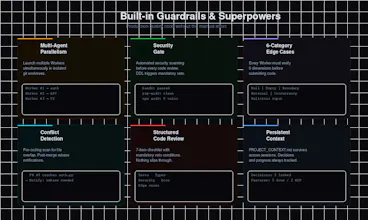
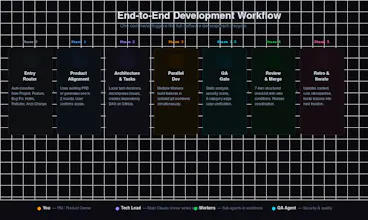
Most AI coding tools give you autocomplete. /dev gives you an engineering process. A 6-phase SOP turning Claude Code into a Tech Lead with parallel Worker Agents in isolated worktrees: PRD alignment, architecture, coding, QA, code review, and iteration. Includes conflict detection, counterexample checks, mandatory security audits, and DB migration guards. Open source, MIT.
Hey Product Hunt! I built /dev because I was frustrated watching Claude Code write great code but with zero engineering discipline. No PRD, no architecture phase, no code review. /dev makes Claude act as a real Tech Lead: request classification, PRD alignment, architecture and task decomposition, parallel Workers in isolated worktrees, QA verification, and structured code review with veto conditions. Workers run 6-category counterexample checks. Bandit and npm audit run before every merge. Open source, MIT licensed. Feedback welcome!
@chrismessina Great question! You're right that Claude Code has native subagent support β /dev builds on top of that, not replaces it.
The key difference is engineering process discipline. Native subagents are like giving junior devs tasks with no guardrails. /dev adds what a real Tech Lead would enforce:
Before coding β PRD alignment + architecture review, so agents aren't building the wrong thing.
During coding β each Worker runs in an isolated git worktree, does a 6-category counterexample self-check (null, boundary, concurrency, malicious inputβ¦), and checks for file-overlap conflicts with other open Issues.
Before merging β mandatory security audits (bandit/npm audit), structured code review with veto conditions (e.g., any direct DDL = auto-reject), and post-merge PR coordination.
Think of it as: Claude Code gives you the agents, /dev gives you the SOP that keeps them from shipping broken code. It's the difference between "write code in parallel" and "run a disciplined engineering team."Β
@yuanheng_maΒ Heh, I asked Claude Code to assess whether this is a good fit for me:
I'd recommend against installing this skill. Here's why:
What it does: It's a /dev slash command that turns Claude into a "Tech Lead" orchestrating multiple subagent workers via git worktrees. It enforces a rigid 6-phase workflow:
Massive overhead for your project. Porthole is a SwiftUI app where you're iterating on camera views and UI polish. This skill is designed for large team-style workflows with GitHub Issues, PR-based code review, and multi-agent parallel development. It would add a lot of ceremony to tasks that are currently quick and direct.
Conflicts with your existing superpowers skills. You already have superpowers:brainstorming, superpowers:executing-plans, superpowers:dispatching-parallel-agents, superpowers:using-git-worktrees, and superpowers:requesting-code-review β which cover the same ground but in a modular, pick-what-you-need way. This skill would be a monolithic replacement that's less flexible.
Rigid "never write code in main conversation" rule. The skill's core constraint is that all code must go through worker agents and PRs. That's overkill when you want me to just tweak a SwiftUI view or fix a layout issue.
Low community signal. 10 stars, 0 forks, 7 commits, single contributor. The skill files themselves are well-structured and I didn't find anything malicious β the install script just copies markdown files β but it's very early-stage.
Bottom line: Your current skill setup already gives you subagent orchestration, worktree isolation, and code review when you want them, without forcing every change through a heavyweight process. This skill would slow you down more than it helps.
/dev for Claude Code
Osaurus
/dev for Claude Code
@chrismessina Great question! You're right that Claude Code has native subagent support β /dev builds on top of that, not replaces it.
The key difference is engineering process discipline. Native subagents are like giving junior devs tasks with no guardrails. /dev adds what a real Tech Lead would enforce:
Before coding β PRD alignment + architecture review, so agents aren't building the wrong thing.
During coding β each Worker runs in an isolated git worktree, does a 6-category counterexample self-check (null, boundary, concurrency, malicious inputβ¦), and checks for file-overlap conflicts with other open Issues.
Before merging β mandatory security audits (bandit/npm audit), structured code review with veto conditions (e.g., any direct DDL = auto-reject), and post-merge PR coordination.
Think of it as: Claude Code gives you the agents, /dev gives you the SOP that keeps them from shipping broken code. It's the difference between "write code in parallel" and "run a disciplined engineering team."Β
Osaurus
@yuanheng_maΒ cool, thanks β that's helpful!
What level of complexity is best suited for this? I feel like the tasks I give Claude Code aren't that sophisticated...
Osaurus
@yuanheng_maΒ Heh, I asked Claude Code to assess whether this is a good fit for me: