
Delphi Pythia
Research platform that measures which arguments change minds
9 followers
Research platform that measures which arguments change minds
9 followers
Polls tell you what people think. Focus groups tell you what they say. Neither tells you which arguments actually change minds. Ask an LLM what the public thinks and you get a plausible hallucination. Delphi Pythia is a deliberation platform: real respondents supply every claim, AI maps the debate, and randomized experiments prove which arguments actually work. Try the AI Governance demo case on the website: https://delphipythia.xyz/ai_governance/
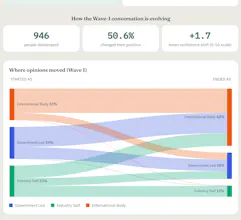


I built Delphi Pythia out of frustration with a simple gap: polls tell you what people think, focus groups tell you what they say - but nothing tells you which arguments actually change minds. And the new wave of "synthetic respondent" AI tools makes it worse: ask an LLM what the public thinks and you get a confident hallucination.
Pythia works the other way around. Real people answer in their own words, and AI only reads and maps, clustering free text into a live picture of every distinct argument in a debate. Then the survey itself becomes an experiment: each respondent is exposed to a randomized subset of arguments, so "this argument is persuasive" is a measured causal effect.
Surprise: the arguments people rate highest are not the strongest movers - the arguments that actually shifted opinions were often different ones.
One thing I'm proud of: the insights are built bottom-up. There are no predefined answer options. The map of the debate is assembled entirely from what respondents actually say, so our own assumptions never shape what we find.
The first pilot ran on "Who should set the rules for AI?" There's a public demo on the site.
Curious: which debate would you start at first?
The argument mapping idea is genuinely interesting, especially the randomized experiments part since so few polling tools actually measure persuasion. One thing that would make this much more useful for me: let me export the full chain of claims, counterclaims, and which arguments moved which demographics as a structured CSV or JSON. Right now the value is locked inside your platform and most researchers will need to feed the results into their own analysis pipelines or share them with stakeholders who never log in.
@teliboyal66574 Great comment, thanks! Adding JSON/CSV export to my roadmap: atomic claims, the counterclaims people wrote against them, ratings, before/after stance shifts, demographics, and per-argument effect estimates with CIs. All of this is already stored, it just needs an access feature. I even can export randomization records, so you can re-run the causal analysis in your own pipeline.