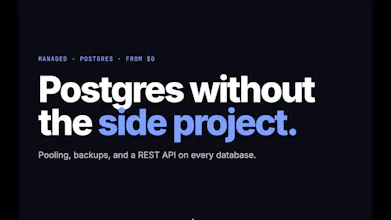
Managed PostgreSQL for indie hackers, hobby devs, small startups, and devtools builders who keep buying VPS boxes just to run Postgres. Every database ships with PgBouncer pooling, daily backups (30-day retention), a REST API, and a CLI. Provision in 60 seconds. From $0/mo, flat pricing.
No reviews yetBe the first to leave a review for DBHost
Maker
📌
Hey Hunters👋 Stian here, solo dev from Norway.
DBHost is for the kind of developer most managed-database products quietly stopped serving:
indie hackers and hobby devs running 4 side projects from a single $10 VPS
bedroom devs shipping a weekend SaaS that needs a real database, not SQLite
small startups that don't want a $25/mo minimum on day one
devtools and small-team builders who need fast, secure, reliable Postgres without paying for a "platform"
If that's you, the workflow it replaces is the boring one:
Self-hosted Postgres on a VPS
your own pg_dump cron
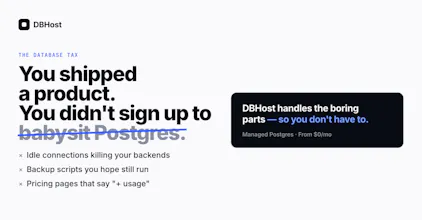
restarting PgBouncer at 2am rotating passwords in a Notion doc / env, and praying the backup actually restores.
DBHost just takes that layer over. Not your backend. Not your stack. Just the Postgres ops.
What you get in your first 60 seconds
a pooled connection string on port 6432 (PgBouncer is already in front)
daily backups already scheduled to S3, 30-day retention
a dashboard for credentials, IP allowlists, and on-demand backups before risky migrations
a REST API
a published CLI @dbhost-app/cli for when scripts replace clicks or its your preference.
Why I think you can trust it before signing up:
The control plane (Next.js on Vercel) is split from the data plane (Postgres on a VPS). If the dashboard goes down, your databases keep accepting connections. That's a deliberate boundary, not a slogan.
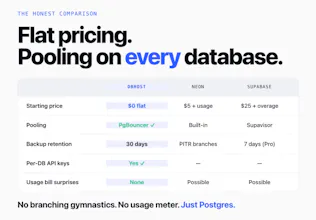
The honest limits, written plainly: no read replicas, no PITR, no multi-region failover yet. If your team needs those today, I'd point you at Neon or RDS. DBHost is for the indie / small-SaaS / internal-tools / staging tier where the operational basics matter more than the scale ceiling.
Flat pricing — $0 / $5 / $15. No usage meter that surprises you on the 1st of the month. Free plan is one full database, no card, same pooling and backups as paid tiers.
Built this because I kept either paying $5/mo minimums PER project or watching usage bills wobble for databases. If that sounds familiar, you're the audience.
What's the part of "running Postgres yourself" that's been stealing the most time from your actual product work?




Hey Hunters👋 Stian here, solo dev from Norway.
DBHost is for the kind of developer most managed-database products quietly stopped serving:
indie hackers and hobby devs running 4 side projects from a single $10 VPS
bedroom devs shipping a weekend SaaS that needs a real database, not SQLite
small startups that don't want a $25/mo minimum on day one
devtools and small-team builders who need fast, secure, reliable Postgres without paying for a "platform"
If that's you, the workflow it replaces is the boring one:
Self-hosted Postgres on a VPS
your own pg_dump cron
restarting PgBouncer at 2am rotating passwords in a Notion doc / env, and praying the backup actually restores.
DBHost just takes that layer over. Not your backend. Not your stack. Just the Postgres ops.
What you get in your first 60 seconds
a pooled connection string on port 6432 (PgBouncer is already in front)
daily backups already scheduled to S3, 30-day retention
a dashboard for credentials, IP allowlists, and on-demand backups before risky migrations
a REST API
a published CLI @dbhost-app/cli for when scripts replace clicks or its your preference.
Why I think you can trust it before signing up:
The control plane (Next.js on Vercel) is split from the data plane (Postgres on a VPS). If the dashboard goes down, your databases keep accepting connections. That's a deliberate boundary, not a slogan.
The honest limits, written plainly: no read replicas, no PITR, no multi-region failover yet. If your team needs those today, I'd point you at Neon or RDS. DBHost is for the indie / small-SaaS / internal-tools / staging tier where the operational basics matter more than the scale ceiling.
Flat pricing — $0 / $5 / $15. No usage meter that surprises you on the 1st of the month. Free plan is one full database, no card, same pooling and backups as paid tiers.
Built this because I kept either paying $5/mo minimums PER project or watching usage bills wobble for databases. If that sounds familiar, you're the audience.
What's the part of "running Postgres yourself" that's been stealing the most time from your actual product work?