Launched this week

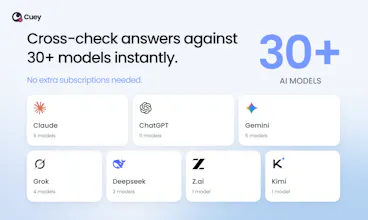
AI gives you wrong answers in the same confident tone as right ones. Cuey cross-checks your AI's answer against ChatGPT, Claude, Gemini, and 30+ other models. It surfaces where they disagree and what your model missed. No copy-pasting between tabs, no repeating yourself, no extra subscriptions. Get a second opinion before you get burned by the first.


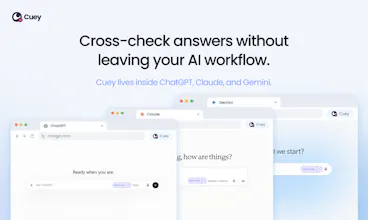
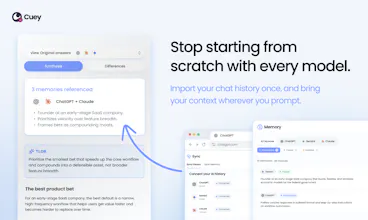


Cuey’s portable context caught my eye.
Reminds me of Ben Thompson’s “Write Things Down”: “actually writing things down is what made learning extendable and scalable.”
Compare the answers, keep the context, become model agnostic and just use whichever is best at the task.
Cuey
@just_kaz That framing is exactly what we're working toward. As the return on model intelligence diminishes, we can begin to optimize model routing to be task specific. Of course, that only works well if your context can travel with you.
Really enjoyed doing mission critical research across models using Cuey.
Cuey
@floydm the centralized access to every major model is great but being able to cross-check your AI's answer against those models is unique. I'm always wondering whether Opus 5 is actually giving me the most optimal answer or not.
MockRabit
Congratulations 👏 I am certainly going to try it.
I remember a friend told me that most of the AI tools mostly gives confident answers. Inspired by his thoughts I created a multi-LLM validation and fact checking MCP server. Ours is in the private domain. We use it for research and fact validation.
Certainly going to use yours.
Cuey
@ishwarjha which models have you seen sound the most confident / yet give incorrect answers?
Otto
love this idea. makes it easy to catch when models blatantly lie to you. if i had a penny...
congrats on the launch.
Kindly Care
Just tried this and it's excellent. I'm a very heavy AI user and I regularly find myself bouncing between ChatGPT and Claude to sanity-check important answers. Cuey basically turned that whole workflow into one click - and on a couple of more nuanced questions, it surfaced differences between the models that were genuinely useful. Really polished implementation of a problem I didn't realize could be solved this seamlessly. Congrats on the launch!
Cuey
@ilebovic wow, thanks so much for the kind words!! let us know if there's anything we can do to make Cuey even better ;)
Dial
the "carries your context across AI tools" part is the actual differentiator here, most compare-tools I've seen make you re-paste the same prompt into three tabs which defeats the point of saving time. one thing I'm curious about: when the models disagree, does Cuey ever try to tell you which one is more likely right, or does it just surface the disagreement and leave the judgment call to you? for a lot of use cases knowing you're wrong is only half the problem, you still need a tiebreaker.
Cuey
@galdayan really good question. Yes you do get more than just the model divergence. After cross-checking your AI's answer against three models, the Enhanced tab gives you a synthesized recommendation drawing from all of the models. You're definitely walking away with actionable insights, not just more information.
Cuey
@galdayan "does Cuey ever try to tell you which one is more likely right"
It’s definitely something we debate internally. Sometimes there’s enough signal to say one answer is more likely right, but it’s often not that clear-cut.
For now, we’re aiming to give you a better-informed answer. Hopefully we can make it easier for you to verify and compare results.
And as you use Cuey, would love to hear what additional signals would be helpful to you.
Dial
@kaz honestly the timestamp on the disagreement itself would be the useful signal for me, if two models agree fast but the third flags something after "thinking longer," that pattern alone tells me where to look closer even before reading the actual content. curious if response latency differences between models are something you're already tracking under the hood
Cuey
@kaz @galdayan We’re not tracking latency as a quality signal. Response times typically reflect model architecture, routing, provider load, and reasoning mode more than answer quality. A slower response doesn’t reliably tell us whether the prompt was harder or the answer was better.
Dial
@kaz @mani_kabir fair, that's a cleaner rebuttal than I expected. routing and provider load alone would drown out any signal from reasoning effort, so it's not really a usable proxy on its own. makes sense you'd need something closer to the model's actual confidence rather than a timing side effect.
This is such a useful idea for avoiding confident ai mistakes having multiple models cross check the answer makes a lot of sense
Cuey
@shivam_kushwaha16 any good stories about being burned by ai mistakes in the past?